Chidambaram and the dancing Shiva
In the small coastal town of Chidambaram, the great temple of Nataraja, Shiva as lord of the cosmic dance, gathers dance, ritual and architecture around a golden-roofed hall at its heart.
i
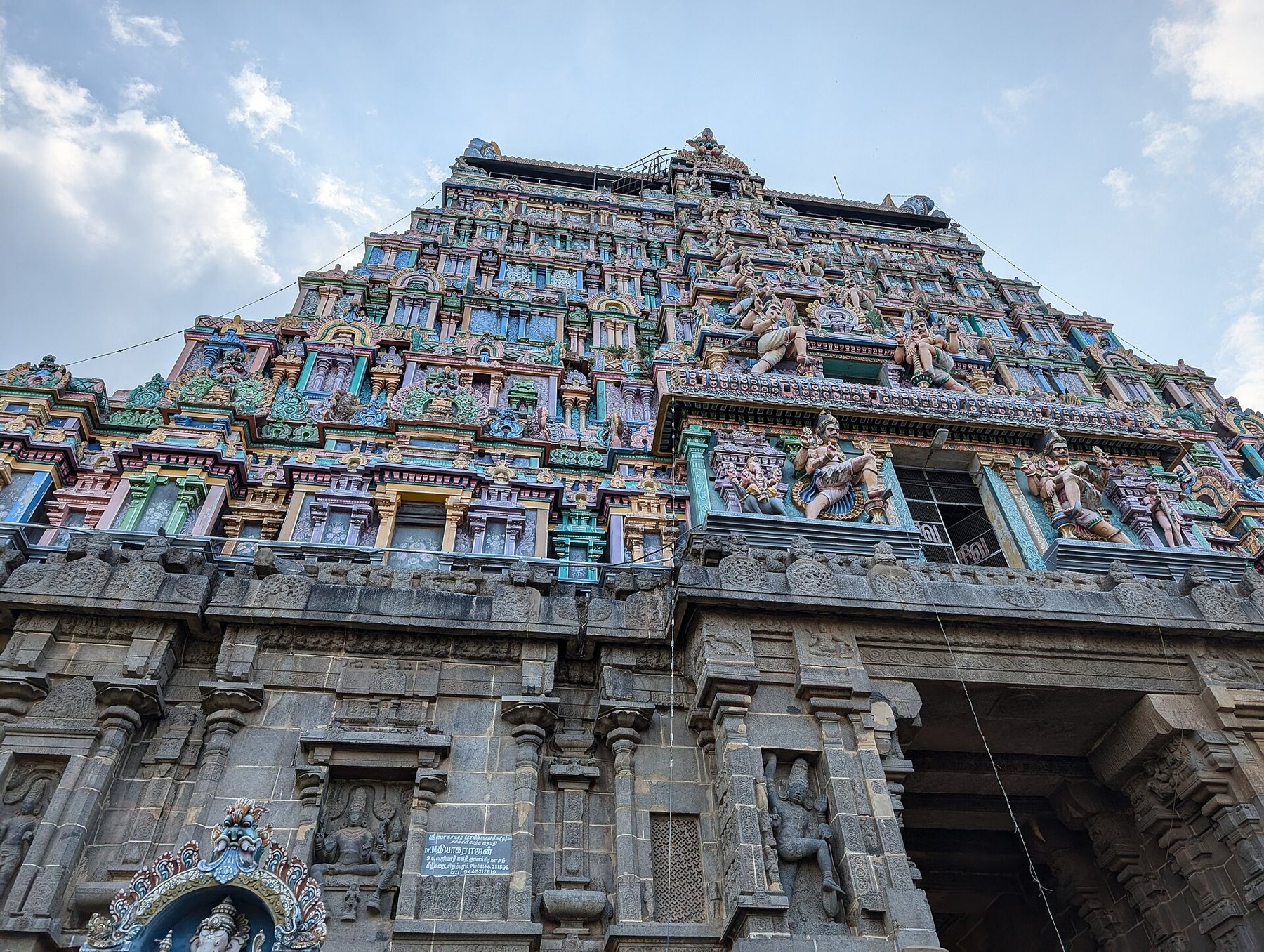
Anonymous0006 · CC0Chidambaram is a small town near the coast of Tamil Nadu, between Chennai and the Kaveri delta. At its centre, covering about forty acres, stands the Thillai Nataraja Temple, dedicated to Shiva in his form as Nataraja, the lord of dance. The image of Nataraja dancing within a ring of fire, one foot raised, has become one of the best-known symbols of Indian art. Here, he is worshipped in a temple where dance, ritual and architecture are woven together.
Nataraja, the lord of dance
In the Nataraja image, Shiva dances the cosmic dance of creation, preservation and destruction. One hand holds a drum, whose beat brings creation; another holds fire, which destroys. One hand is raised in a gesture of protection, another points to the raised foot, offering release. Beneath his other foot lies a small figure representing ignorance. Chidambaram is regarded as the place where Shiva performed this dance, and the temple's main image is a bronze Nataraja.
The golden hall
At the heart of the temple stands the Chit Sabha, the hall of consciousness, where Nataraja is enshrined. Its roof is covered in gold, giving it the name Ponnambalam, the golden hall. Beside the image, a curtained space represents the formless aspect of Shiva, associated with space or ether, one of the five elements. When the curtain is drawn back during worship, there is nothing visible, only an empty space hung with golden leaves. This is the famous secret of Chidambaram.
i
Matthew T Rader · CC BY-SA 4.0The dance poses on the gopurams
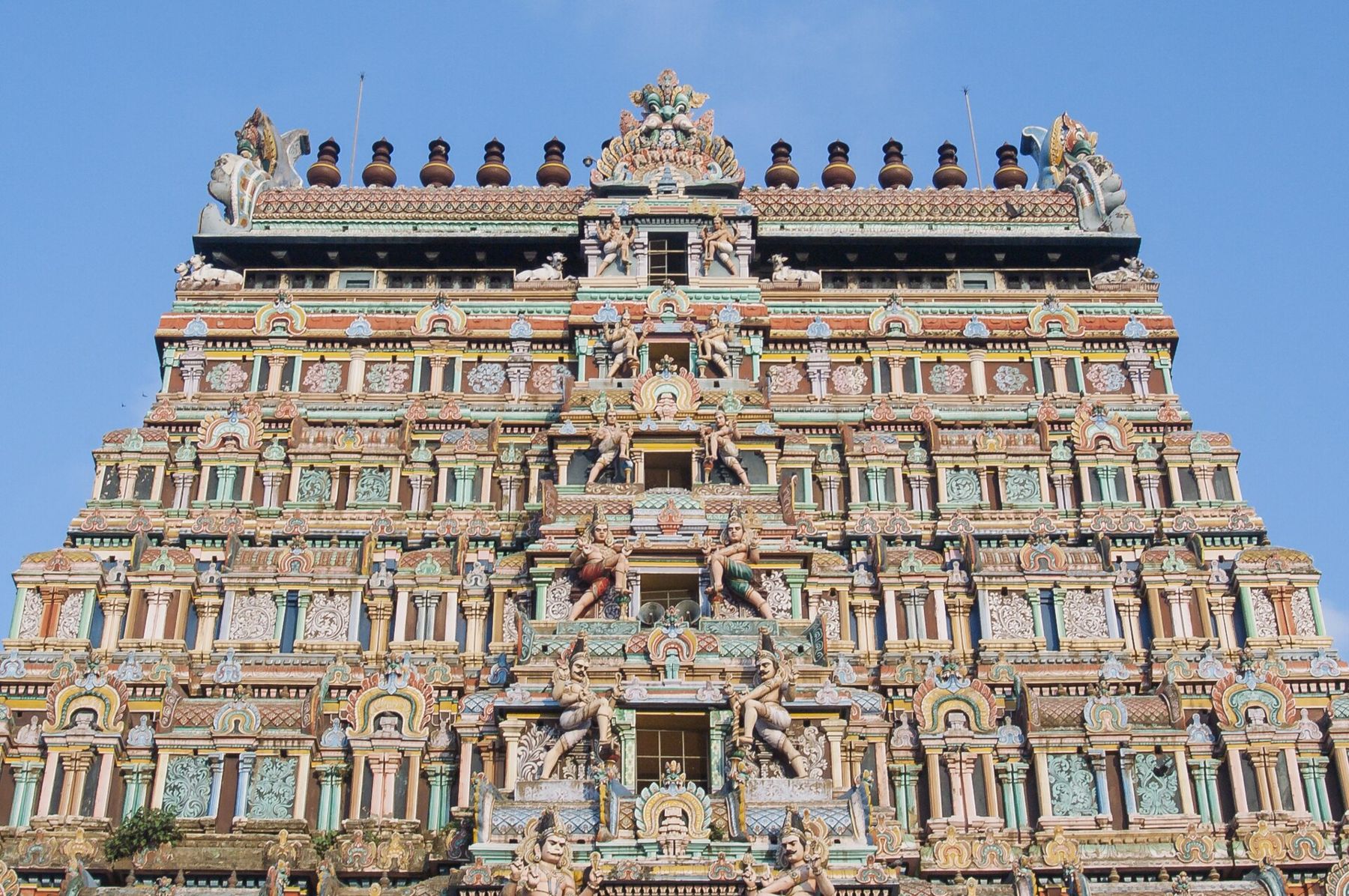
The temple's four great gopurams, at the cardinal points, are among its glories. On the passageways through the eastern and western gateways, small carved panels show dancers in the poses described in the Natya Shastra, an ancient treatise on dance and drama. They are a visual catalogue of classical dance, and dancers and scholars come to study them. Look closely: each panel captures a moment of movement in stone.
The priests
The temple is served by a community of hereditary priests, the Dikshitars, recognisable by their distinctive hair knot tied at the front of the head. They perform the daily rituals and have traditionally managed the temple. Their rites, with lamps, bells and chanting, follow an ancient and carefully kept order.
When the curtain is drawn back during worship, there is nothing visible, only an empty space hung with golden leaves.
Shiva and Vishnu together
Unusually, the temple also contains a major shrine to Vishnu, as Govindaraja, reclining near the Nataraja hall. The two shrines face each other across the space, and the temple is holy to both Shaiva and Vaishnava traditions. Standing between them, you can see both in a single view.
i
Rainer Halama · CC BY-SA 4.0Festivals and dance
The temple's great festivals include Arudra Darshan in the month of Margazhi, in December or January, and Aani Thirumanjanam in June or July, both with car processions and ritual bathing of Nataraja. Around Maha Shivaratri, a festival of classical dance is held in the temple, with dancers performing before the deity. These are crowded, joyful occasions; check dates each year.
The Shivaganga tank
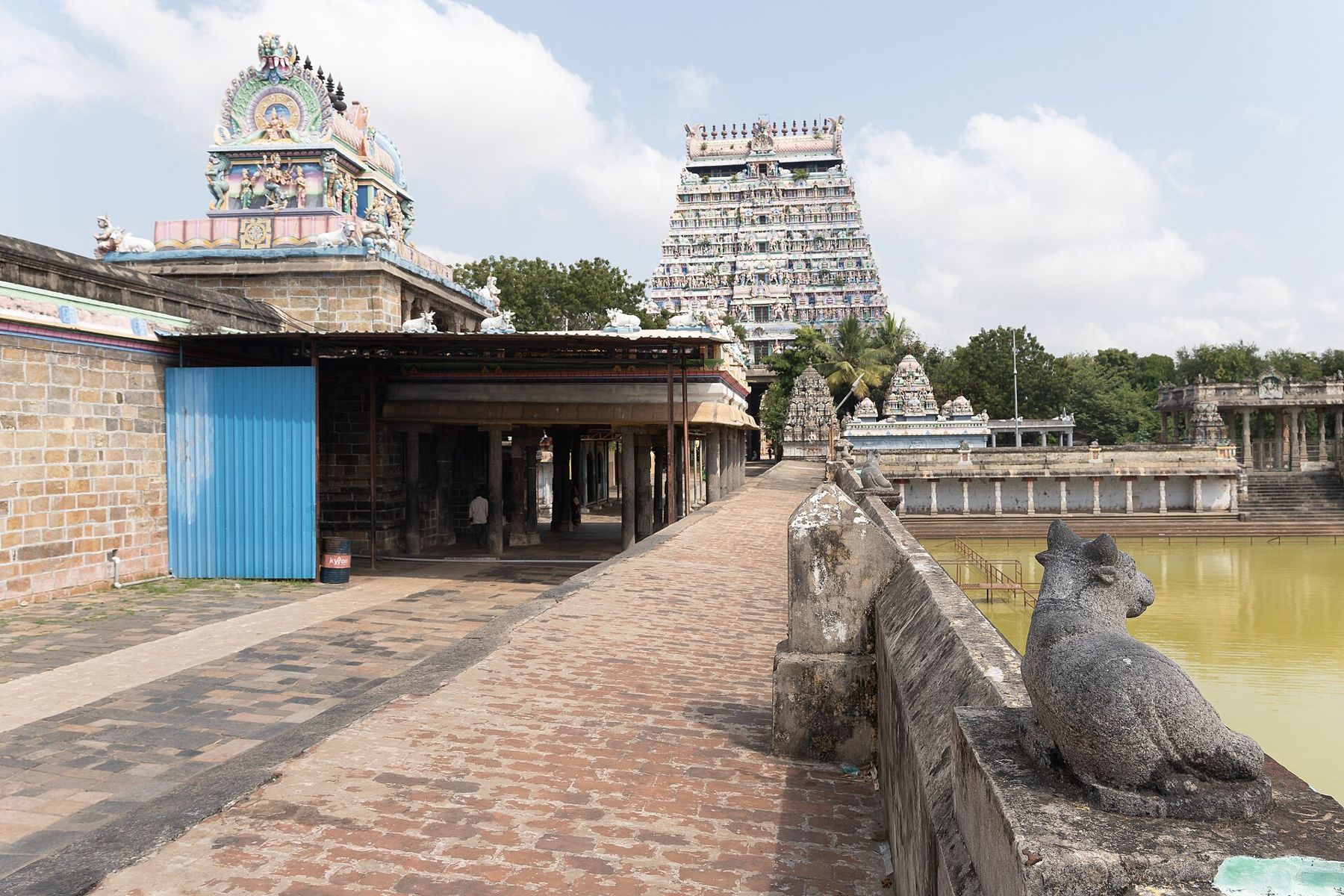
Within the temple stands the Shivaganga, a large temple tank surrounded by stepped sides and pillared corridors. Pilgrims bathe or sprinkle themselves with its water before worship. Sitting by the tank in the early evening, as the lamps are lit and the gopurams glow, is one of the quiet pleasures of a visit.
Around Chidambaram
About fifteen kilometres from the town, the Pichavaram mangroves form a maze of channels and islands near the coast, explored by rowing boats. The mangroves are a protected area, important for birds and fish, and a peaceful contrast to the busy temple. Boats are run under local arrangements; check details on the spot. The coast nearby was badly hit by the 2004 tsunami, and the mangroves are credited with reducing its impact in some places.
A day in Chidambaram
Chidambaram is small and easy to navigate. Arrive early for the morning rituals, return to your lodging through the heat of midday, and go back to the temple in the late afternoon for the evening worship, when the lamps are lit and the bells ring. A visit to the mangroves fits comfortably into the afternoon, and the boatmen know the channels well. The town's streets around the temple are lined with shops selling flowers, offerings and brass lamps, and with simple vegetarian eating places.
Many visitors stay a night here between Chennai and the delta, and the slow evening at the temple is often a highlight of their journey.
Chidambaram is also a university town, with a large campus on its edge, and its streets have a lively, unpretentious feel. Outside festival days, the temple is busy but rarely overwhelming, and early mornings can be wonderfully calm, with the first rituals, the scent of camphor and the stone still cool underfoot.
Evenings are the best time of all.
Notes from the gate
- Shoes are left outside. Shoulders and knees should be covered, and men may be asked to remove shirts in inner areas.
- Entry to the inner hall may be restricted; follow the instructions of the priests and staff.
- Photography is limited inside; ask before taking pictures.
- The temple closes for part of the afternoon; the evening rituals are especially atmospheric.
Plan the journey with linking the six towns, and time your visit with a year of temple festivals. For the temple manners that apply here, read visiting a Tamil temple well.