The Nayak palace and the Teppakulam tank
Southeast of the Meenakshi temple, a seventeenth-century palace of giant pillars and a vast square temple tank show the grandeur of the Nayak kings who rebuilt Madurai.
i
Sundaram Perumal · CC BY-SA 4.0The Meenakshi temple dominates Madurai, but the city's rulers also built for themselves. In the seventeenth century, the Nayak king Thirumalai, under whom Madurai reached the height of its power, raised a great palace southeast of the temple, and a little further out, an enormous square tank with a temple island at its centre. Both survive, in part, and both are among the most impressive monuments in the city.
The Nayaks of Madurai
The Nayaks began as governors for the Vijayanagara empire and became independent rulers in the sixteenth century, as Vijayanagara's power declined. They ruled a large part of southern Tamil Nadu from Madurai. Thirumalai Nayak, who reigned in the first half of the seventeenth century, is remembered as the greatest of them, a patron of temples, palaces and festivals. Much of the Madurai you see today, including large parts of the Meenakshi temple, owes its form to the Nayak period.
The palace
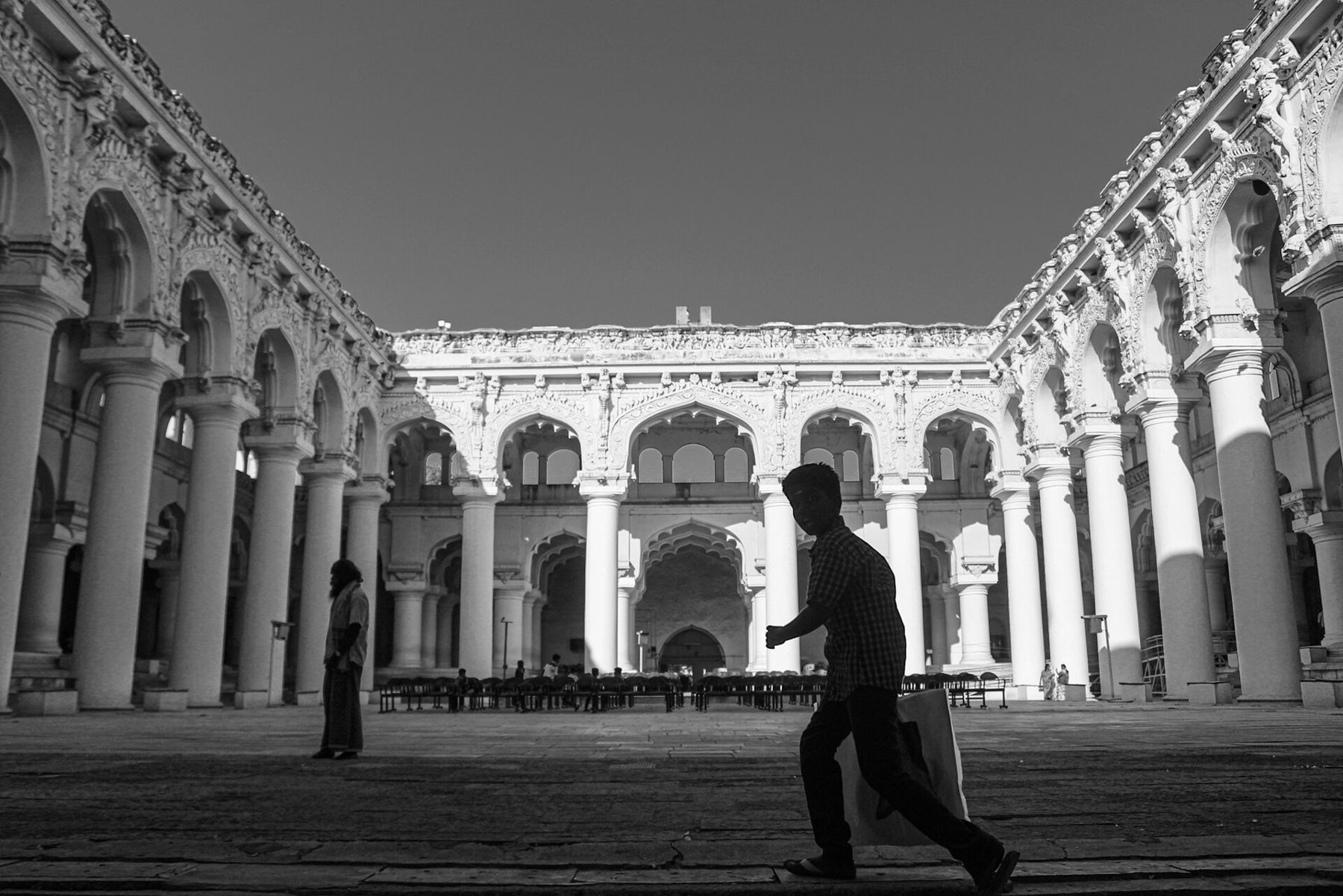
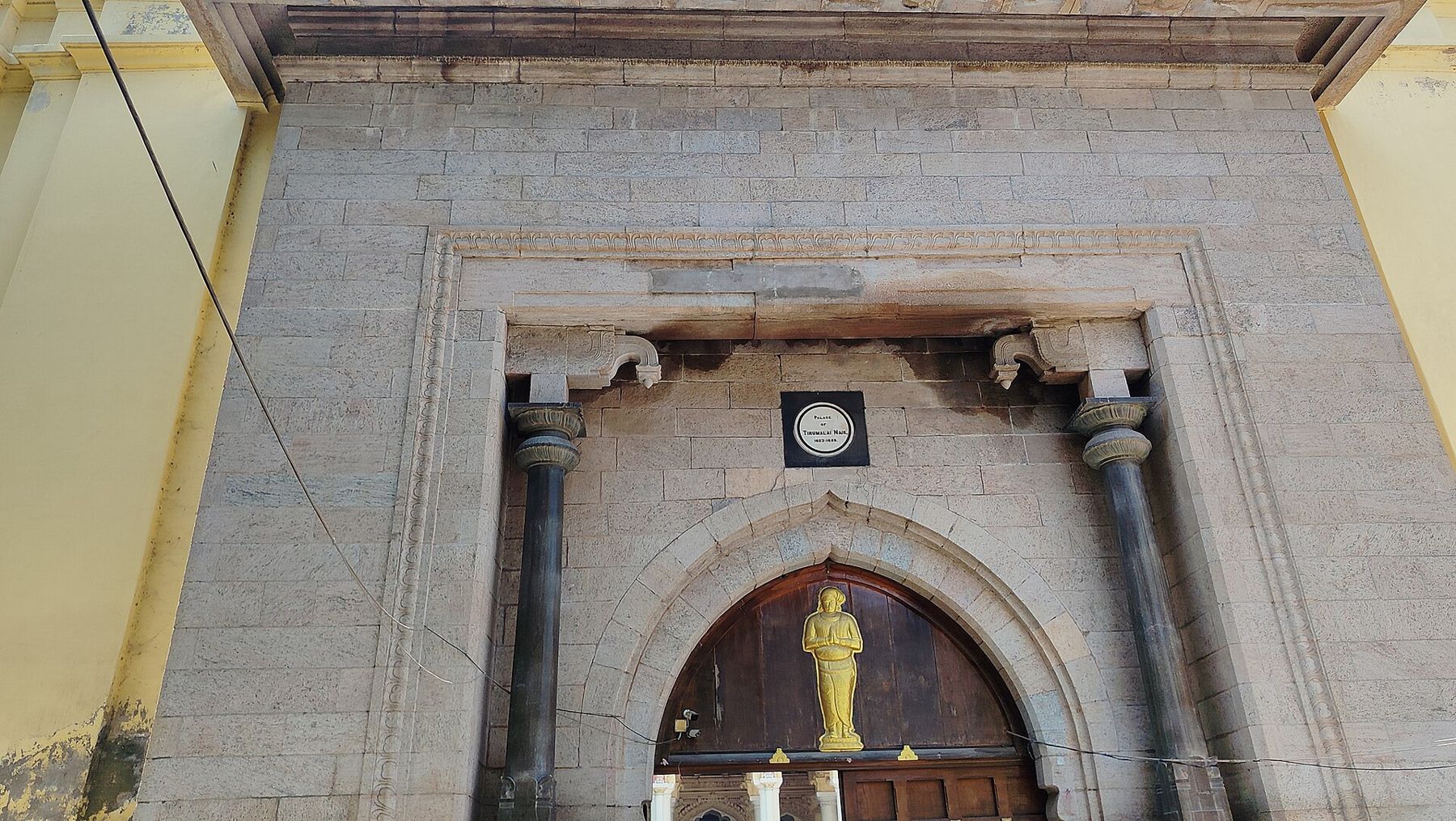
The palace was completed in 1636. Only a part of the original complex survives, but what remains is on a heroic scale. The main courtyard, known as the Swarga Vilasam, is surrounded by colonnades of enormous round pillars, some many metres tall, linked by arches and topped by stucco decoration. At one end rises a great hall with a high dome. The style mixes Dravidian and Islamic elements, with arches and domes alongside South Indian ornament.
i
Shajinss · CC BY-SA 3.0After the Nayaks, the palace fell into decay, and parts were demolished for their materials. In the nineteenth century, under British rule, it was partly restored. Today it is a protected monument, with a small museum and gardens in the courtyard.
Walking the courtyard
Walk slowly around the courtyard and look up. The scale of the pillars is the first impression, but the details reward attention: the painted and moulded ceilings, the arches, the patterns in the stucco. In the late afternoon, light slants between the columns and the stone glows. The palace is a pleasant break from the crowds at the temple, and a good place to understand the power of the Nayak court.
The sound and light show
In the evenings, a sound and light show has been held in the courtyard, telling the story of Thirumalai Nayak and the palace in English and Tamil, with lighting on the pillars and arches. Timings, languages and ticket arrangements change, so check locally if you want to see it.
The Mariamman Teppakulam
A few kilometres east, the Vandiyur Mariamman Teppakulam is one of the largest temple tanks in South India: a huge square of water, or sometimes dry ground, surrounded by stone steps, with a pavilion on an island in the middle. It is also associated with Thirumalai Nayak, whose builders are said to have dug the soil here for bricks for the palace. A temple to the goddess Mariamman stands nearby.
Storey I · MaduraiMeenakshi Amman Temple: fourteen towers and a thousand pillarsThe tank is filled from the Vaigai river through channels, and its water level varies greatly. In dry years it may be almost empty, and local boys play cricket on its floor. When it is full, the reflections of the central pavilion and the surrounding trees make a beautiful scene.
The float festival
The tank's great day is the float festival, held in the Tamil month of Thai, usually in late January or early February. The deities of the Meenakshi temple, Meenakshi and Sundareswarar, are brought in procession to the tank, placed on a raft decorated with flowers and lights, and drawn around the central island. Crowds fill the steps around the tank. At night, with the raft lit and the reflections on the water, it is one of Madurai's most memorable sights.
Madurai in the Nayak age
Under the Nayaks, Madurai was a capital of great wealth, ceremony and building. Kings sponsored festivals that drew people from across the region, endowed temples with land and jewels, and built halls, tanks and palaces. Much of the city's festival calendar, including the great Chithirai festival, took on its present form in this period. The palace and the tank are the most visible secular monuments of that age, while the temple holds the sacred ones.
Visiting the palace and the tank together, after a morning at the temple, gives a full picture of the Nayak city: the god at the centre, the king nearby, and the great public spaces where the two met at festival time.
Both sites are easy to reach by auto-rickshaw from the temple area. The palace is a comfortable walk from the southern Chithirai streets; the tank is further out and best reached by road. In the hot months, see the palace in the late afternoon, when the courtyard is shaded, and stay for the evening show if it is running.
Bring a hat for the open courtyard, and water for the walk out to the tank.
Notes from the gate
- The palace charges entry and keeps set hours; check before going.
- The courtyard is open to the sky; bring a hat in the middle of the day.
- The tank is free to visit; the central island is not usually reachable except during festivals.
- Festival dates follow the Tamil calendar; confirm them each year.
For the temple at the city's heart, read the Meenakshi temple, and for the streets around it, Madurai's ring streets. The float festival's place in the year is covered in a year of temple festivals.