Meenakshi Amman Temple: fourteen towers and a thousand pillars
The temple at the centre of Madurai is a walled city of its own, with painted gateway towers, a sacred tank, long pillared halls and a ritual day that runs from before dawn until late at night.
i
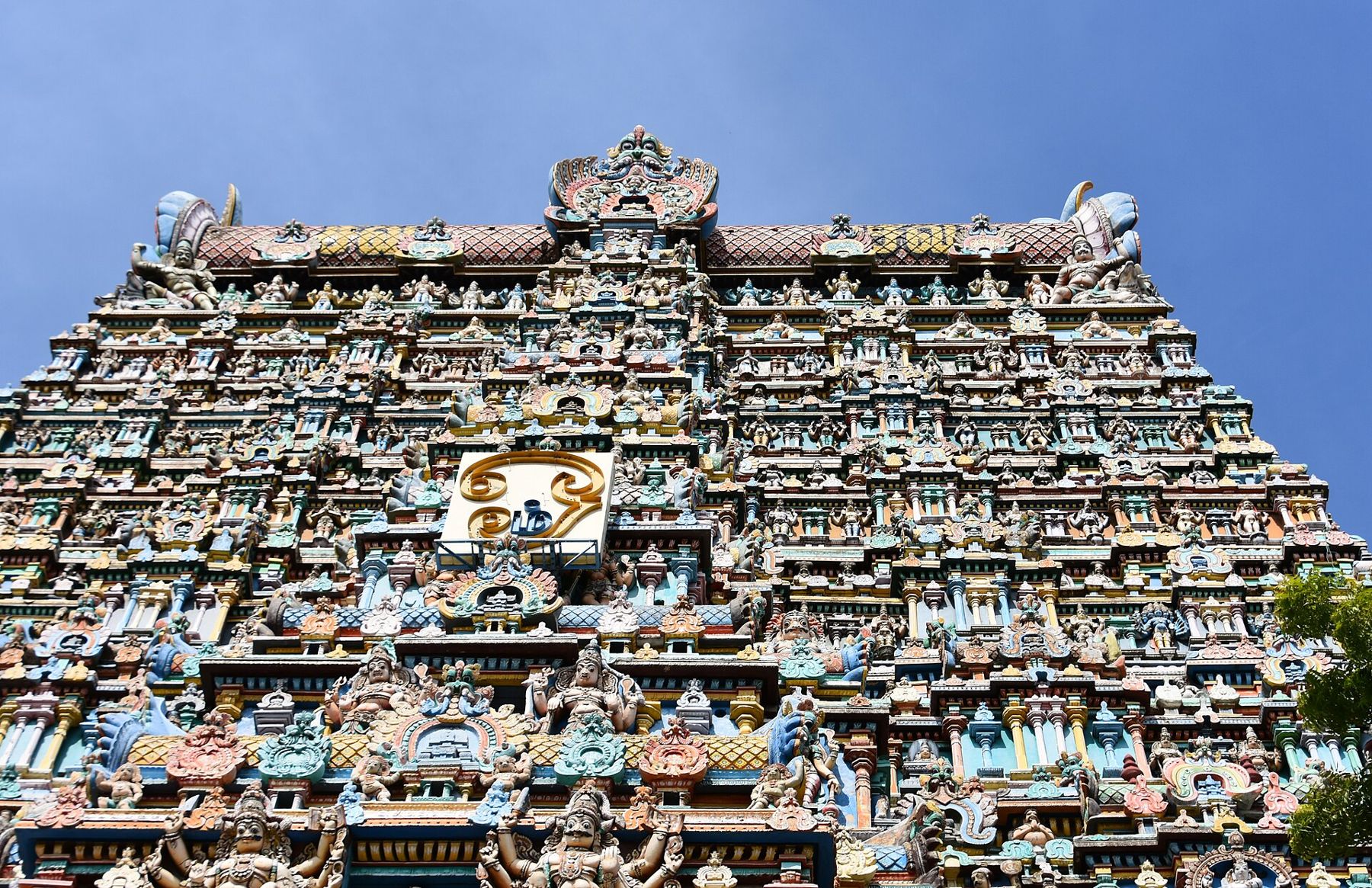
Richard Mortel from Riyadh, Saudi Arabia · CC BY 2.0Madurai grew around one building, and the building is still there in the middle of it. The Meenakshi Amman Temple covers a walled rectangle of roughly fifteen acres on the south bank of the Vaigai, and its gateway towers can be seen from almost every rooftop in the old city. It is dedicated to Meenakshi, a form of the goddess Parvati, and to her consort Sundareswarar, a form of Shiva. Most visitors come for the towers. Most leave remembering the inside: the dim halls, the oil lamps, the crowds moving in a slow current toward the shrines.
A temple rebuilt in stone and stucco
A temple has stood here for well over a thousand years, and Tamil literature links Madurai to the goddess far earlier still. The complex you walk through today, though, is largely the work of the Nayak rulers of the sixteenth and seventeenth centuries, who rebuilt and enlarged it after the upheavals of the fourteenth century. They gave it its outer walls, most of its halls and the great gateways that now define the skyline.
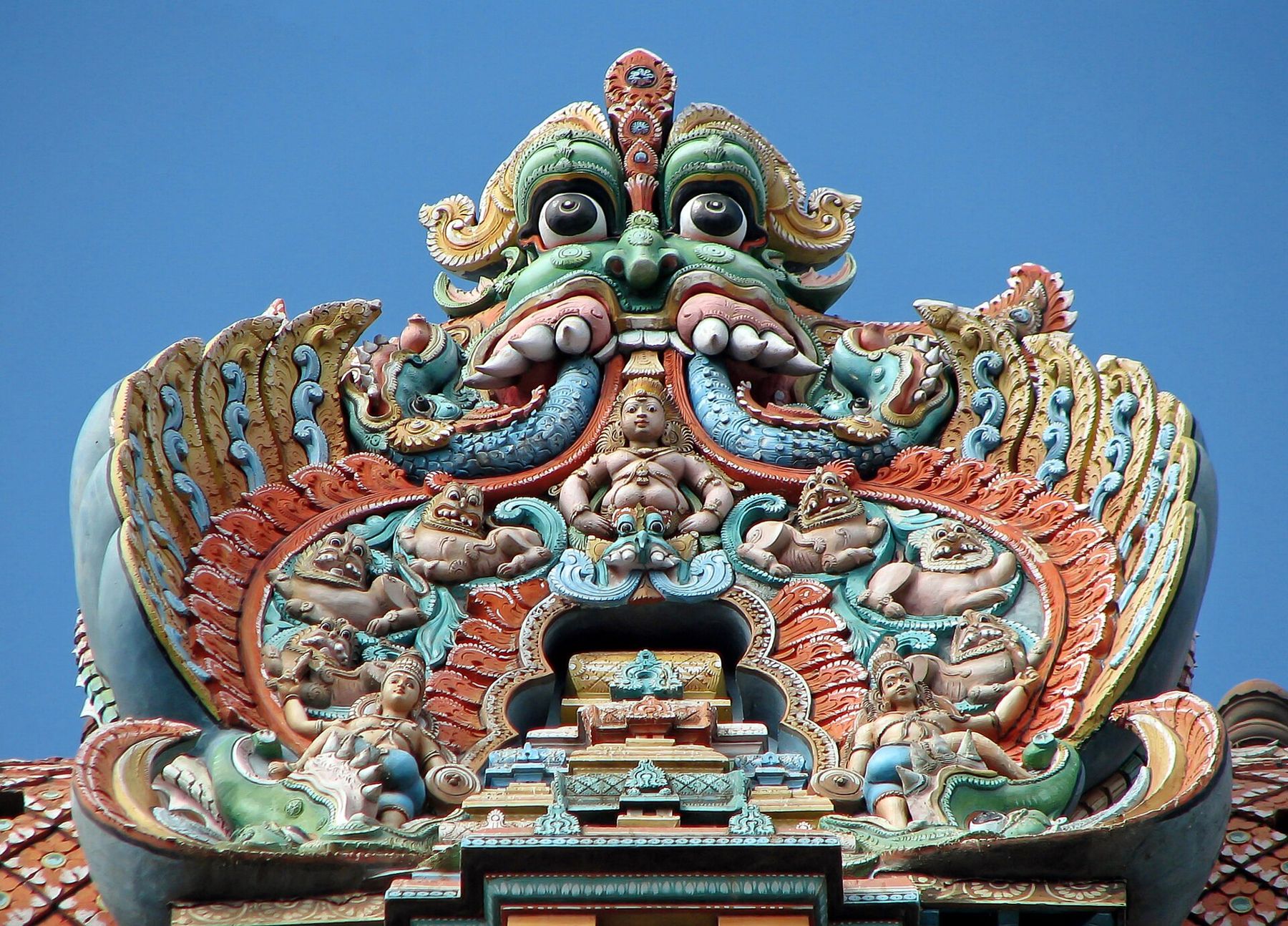
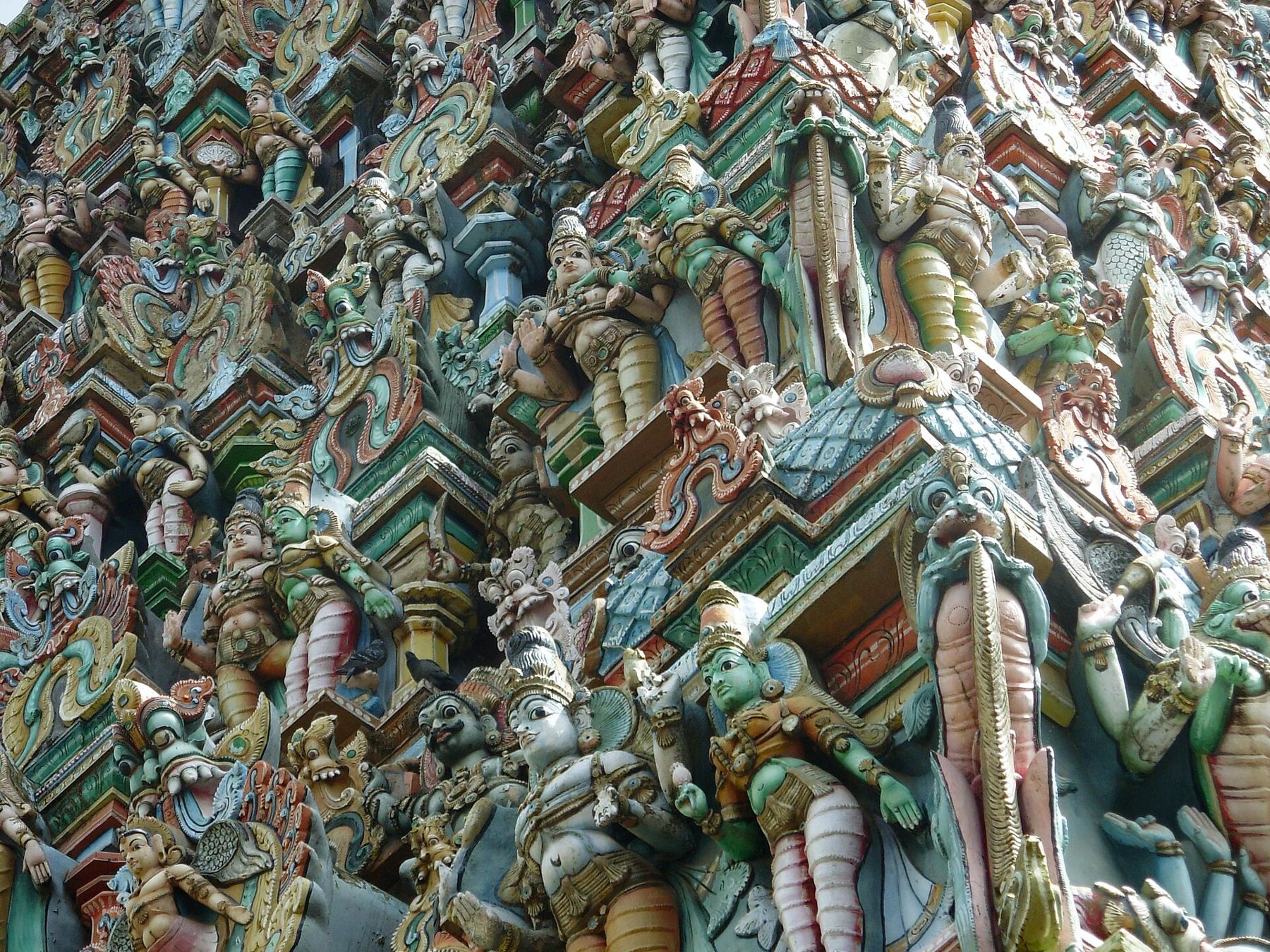
There are fourteen gopurams in all. Four tall ones stand in the outer wall at the cardinal points, and the southern one is the tallest, rising to roughly fifty metres. Smaller gateways mark the inner enclosures. Every tier is crowded with painted stucco figures: gods, goddesses, guardians, animals and scenes from the stories of Shiva and Meenakshi. The colours are bright because they are renewed. The temple is repainted and reconsecrated at intervals of roughly twelve years, so the towers you see are both very old in form and fresh in their skin.
i
Bernard Gagnon · CC BY-SA 3.0Look at a tower from a little distance first, then come close. From the street, the figures merge into a single shimmering pattern. At the foot of the gateway they separate into individual faces, each with its own pose, weapon and expression. A pair of binoculars is not out of place here.
The Golden Lotus Tank
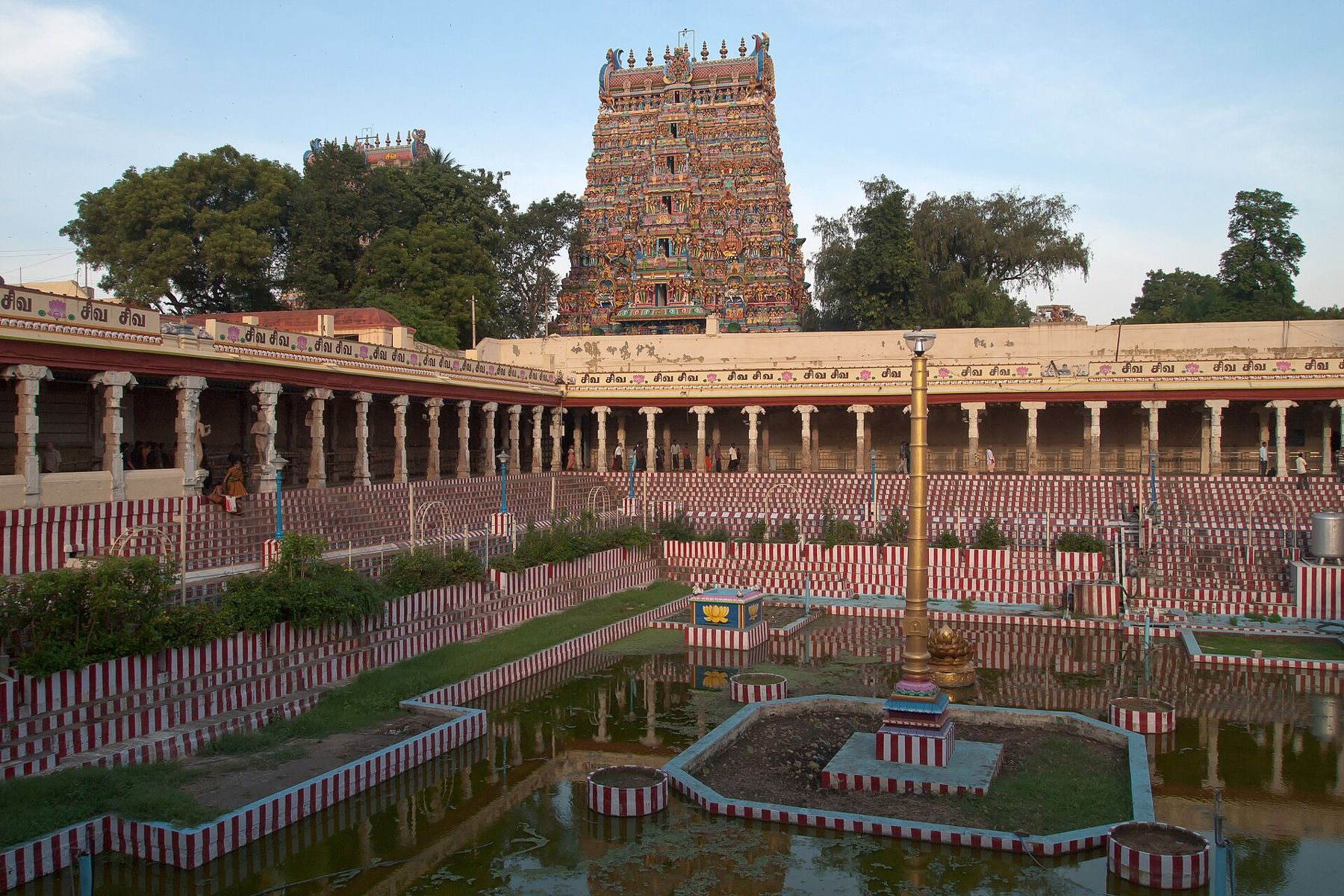
Inside the outer wall, the first open space most people reach is the Porthamarai Kulam, the Golden Lotus Tank. It is a rectangular pool with stepped sides and a pillared walkway around it, and a gilded lotus stands in the water. From its southern side you get one of the best views in the temple: the golden roofs over the main shrines with the southern gopuram rising behind.
i
Vyacheslav Argenberg · CC BY 4.0The tank has a place in Tamil literary tradition: it was said to judge the worth of poems, letting good work float and sinking the rest. Whatever you make of that, the steps make a good place to sit, cool off and watch the temple at its own pace. The walls of the corridor around it carry painted scenes, many of them telling the stories of Shiva's sacred play in Madurai.
Storey I · MaduraiMadurai's ring streets, named for Tamil monthsHalls, pillars and the inner shrines
The temple is a sequence of mandapams, pillared halls, each with its own character. Near the eastern entrance the Ashta Shakti Mandapam has sculpted pillars showing eight forms of the goddess. Elsewhere you pass halls lined with stalls selling flowers, offerings, bangles and pictures, which is not a modern intrusion: temple bazaars have always been part of the place.
The best known is the Hall of a Thousand Pillars, built in the sixteenth century. The real count is a little under a thousand, and the hall now houses a small art museum with bronzes and carvings. Its rows of carved columns, each a slightly different figure, are worth walking slowly. Nearby, a set of stone pillars is known for ringing with different notes when tapped; touching is generally discouraged now, so listen rather than strike.
The real count is a little under a thousand, and the hall now houses a small art museum with bronzes and carvings.
The two main shrines, to Meenakshi and to Sundareswarar, stand at the heart of the complex. Entry to the inner sanctums has long been restricted to Hindus, and signs and staff show where other visitors should stop. Even from the outer corridors, you can watch the queues, hear the bells and see the lamps carried in. Treat the space as a place of worship first: no pointing feet at shrines, no loud talk, and no stepping over people seated in prayer.
i
Flickr user Hector Garcia · CC BY-SA 2.0The temple's day
The temple opens early in the morning and closes for a few hours in the middle of the day before reopening in the late afternoon and staying open into the night. The exact hours vary with the season and festivals, so check at the gate or on the temple's notices before you plan around them.
The last ritual of the day is one of the most moving to watch from the edge. Each night the image of Sundareswarar is carried in a palanquin to Meenakshi's shrine, accompanied by drums, pipes and lamps, so that the divine couple can rest together. Priests and devotees fill the corridor. It is a ritual, not a performance, so stand back, keep out of the way of the bearers and resist the urge to film.
Outside festival seasons, the temple still has a calendar of its own: the deities are dressed and decorated differently on particular days, and small processions move around the inner corridors on many evenings. Ask at the temple office or watch the notice boards near the gates, and you may find that your ordinary weekday visit coincides with something special.
Practical notes for a first visit
- Shoes: leave them at the counters outside the gates. The stone floors are cool inside but the open courtyards bake by midday, so socks help.
- Phones and cameras: in recent years mobile phones and cameras have not been allowed inside, and there are deposit counters near the gates. Rules change, so ask before you queue.
- Dress: shoulders and knees covered for everyone. A light scarf or shawl solves most problems.
- Timing: early morning is calmest. Evenings are busier but full of life, and the night procession comes at the end.
- Festivals: the Chithirai festival in April or May, when the marriage of Meenakshi and Sundareswarar is celebrated, draws enormous crowds.
Give the temple at least two or three hours, and come back a second time if you can, once in daylight and once after dark. From here, the nearby palace and the float tank complete the picture: read about them in the Nayak palace and the Teppakulam, and see a year of temple festivals for the dates that change the city. For temple manners in general, visiting a Tamil temple well covers the basics.