Walking inward through Srirangam's seven enclosures
On an island in the Kaveri river, the temple of Ranganatha is a town in its own right: seven concentric walls enclose streets, houses, markets and halls, growing quieter and holier toward the reclining god at the centre.
i
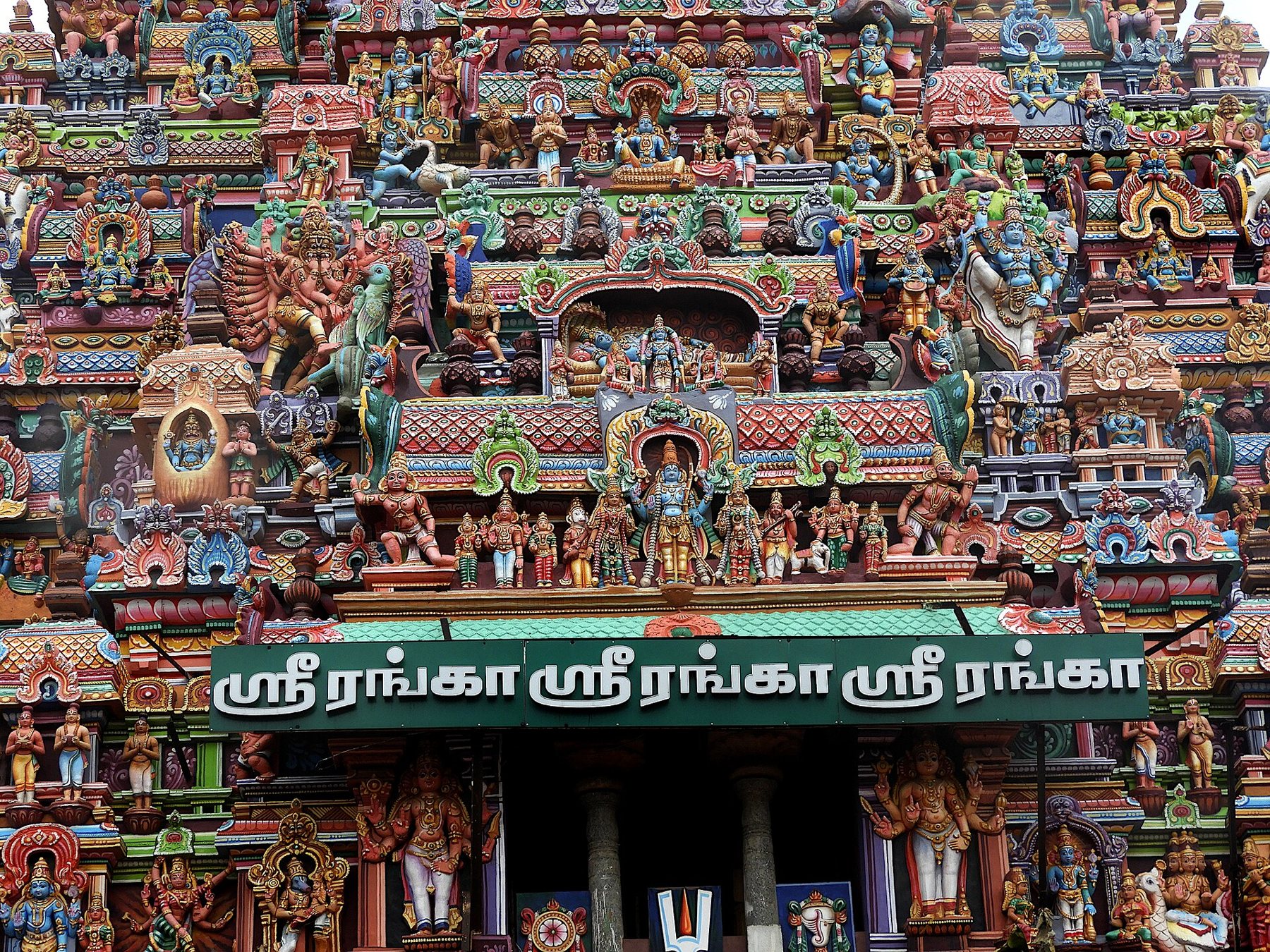
Sumita Roy Dutta · CC BY-SA 4.0Srirangam is an island in the Kaveri river, beside the city of Tiruchirappalli, and the island is dominated by one temple. The Sri Ranganathaswamy Temple, dedicated to Vishnu as Ranganatha, reclining on the coils of the serpent Adisesha, is one of the largest functioning Hindu temples in the world. It is built as seven concentric rectangular enclosures, one inside the other, and the outer ones contain whole streets of houses, shops and markets. Walking from the outer gate to the centre is like walking from a town into a sanctuary.
The first of the holy places
For Vaishnavas, followers of Vishnu, Srirangam holds a special place. It is counted first among the 108 holy sites of Vishnu praised by the Alvars, the Tamil saint-poets, and it was closely associated with the great teacher Ramanuja, who lived and taught here in the eleventh and twelfth centuries. The temple has been built and rebuilt over many centuries by Cholas, Pandyas, Hoysalas, the Vijayanagara rulers and the Nayaks. During the invasions of the fourteenth century, the temple's image was carried away for safety and later brought back.
The Rajagopuram
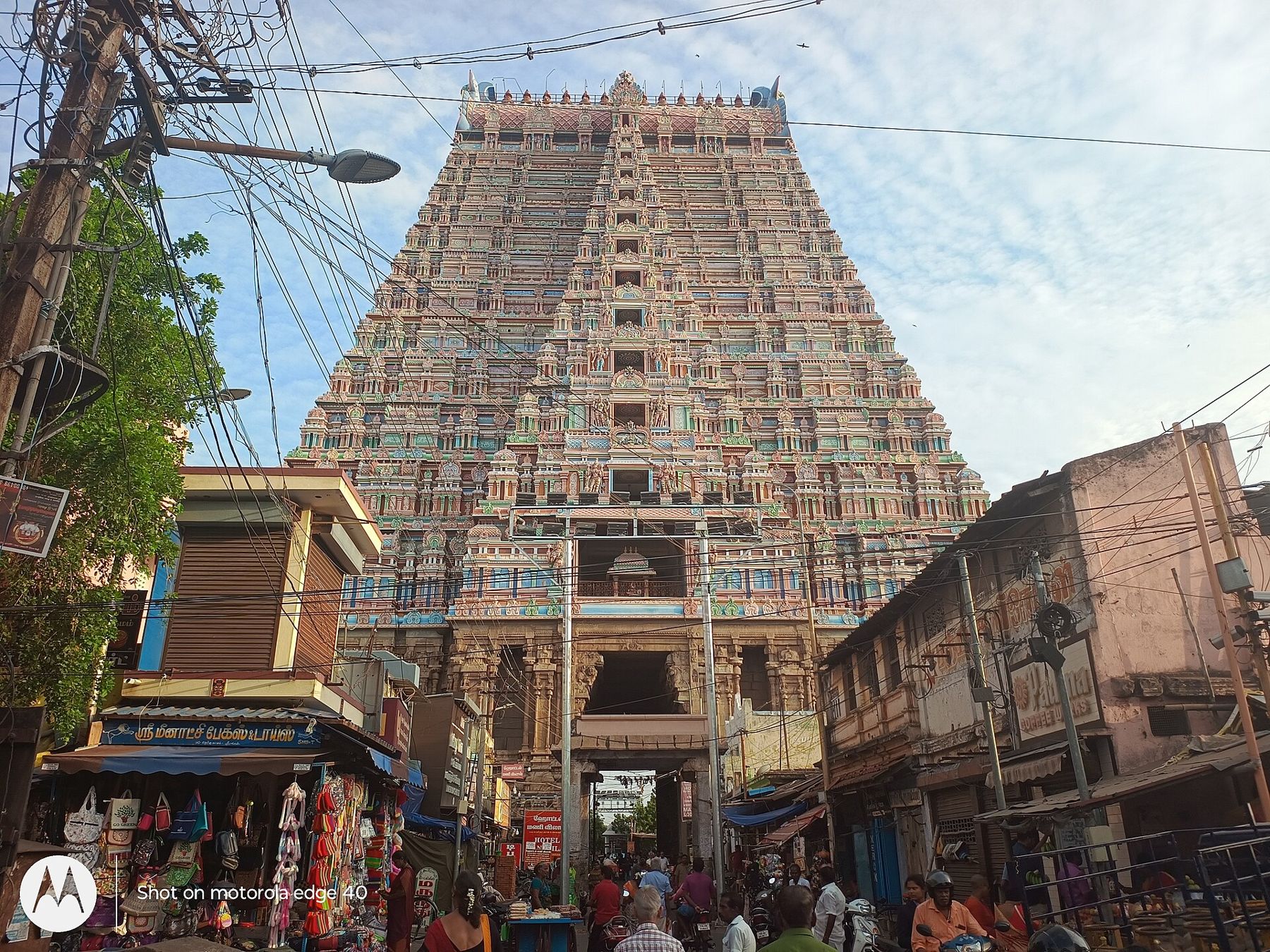
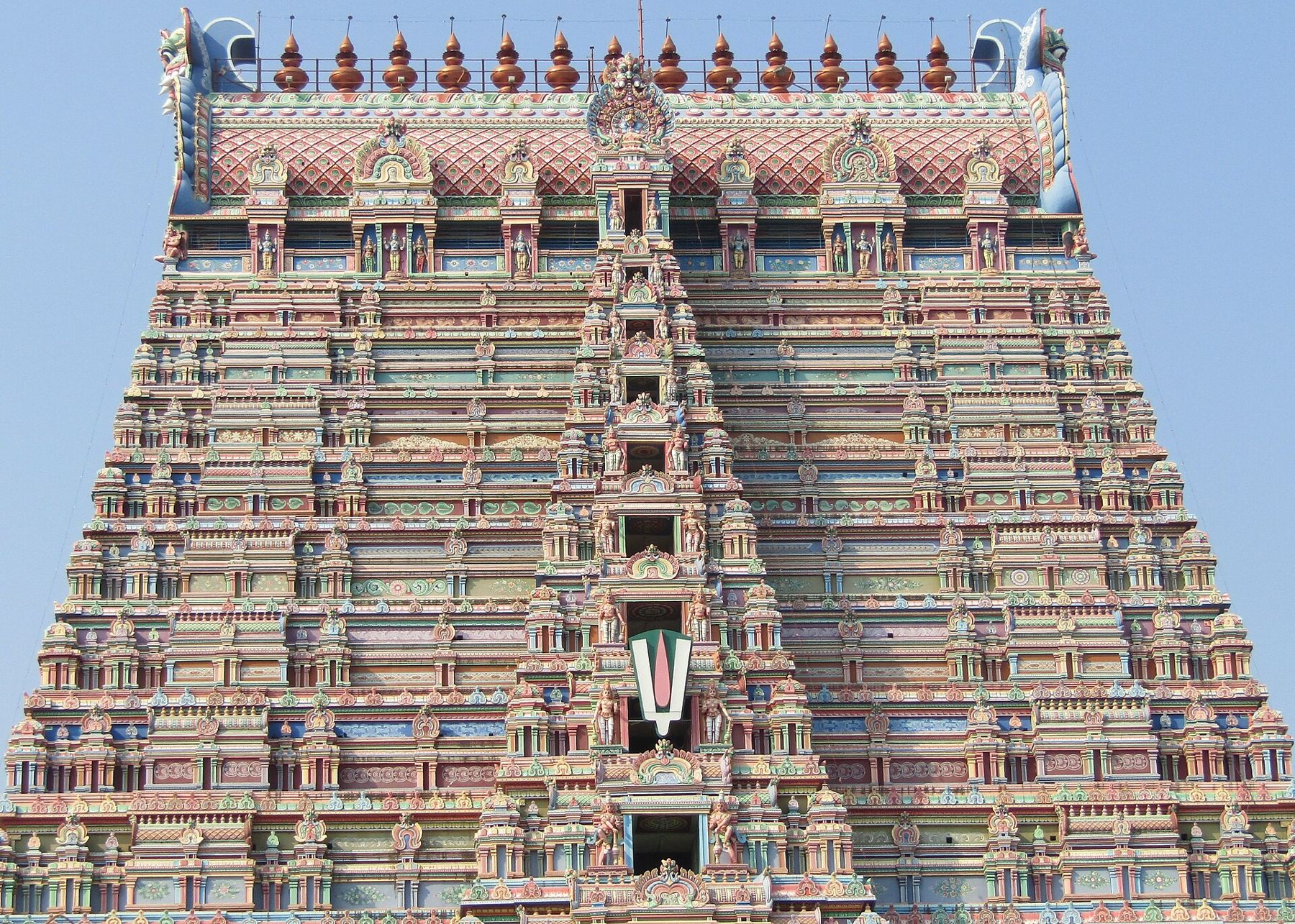
The southern entrance is marked by the Rajagopuram, the royal gateway tower. It rises to around seventy metres, one of the tallest temple towers in Asia. Its base dates from centuries ago, but the tower itself was completed only in 1987, after being left unfinished for a long time. It is visible across the island and from the Rockfort in Tiruchirappalli on the far bank.
i
N. Vivekananthamoorthy · CC BY 4.0Walking inward
The outer three enclosures are part of the town: streets lined with houses, shops selling flowers, brassware and religious items, and small eating places. People live here, and traffic moves through the gateways. Each wall is pierced by gopurams at the cardinal points. As you pass through the fourth wall, the atmosphere changes: you are now inside the temple proper, with halls, shrines and courtyards.
The inner enclosures grow quieter and more sacred. Shoes are left before entering the temple area, and dress rules apply. The innermost shrine, with the reclining image of Ranganatha, is open only to Hindus, as in many Tamil temples. Signs and staff show where other visitors should stop.
Walking from the outer gate to the centre is like walking from a town into a sanctuary.
The horse pillars and the halls
One of the great sights of Srirangam is the Sesharaya mandapam, a hall whose front pillars are carved as rearing horses with riders, attacking mythical beasts, each horse taller than a person. The carving is extraordinarily lively, a masterpiece of the Vijayanagara and Nayak period. Nearby, a hall of a thousand pillars hosts festivals. Many other halls, shrines and corridors fill the inner enclosures; take time to wander.
i
Ramya srivastav · CC BY-SA 4.0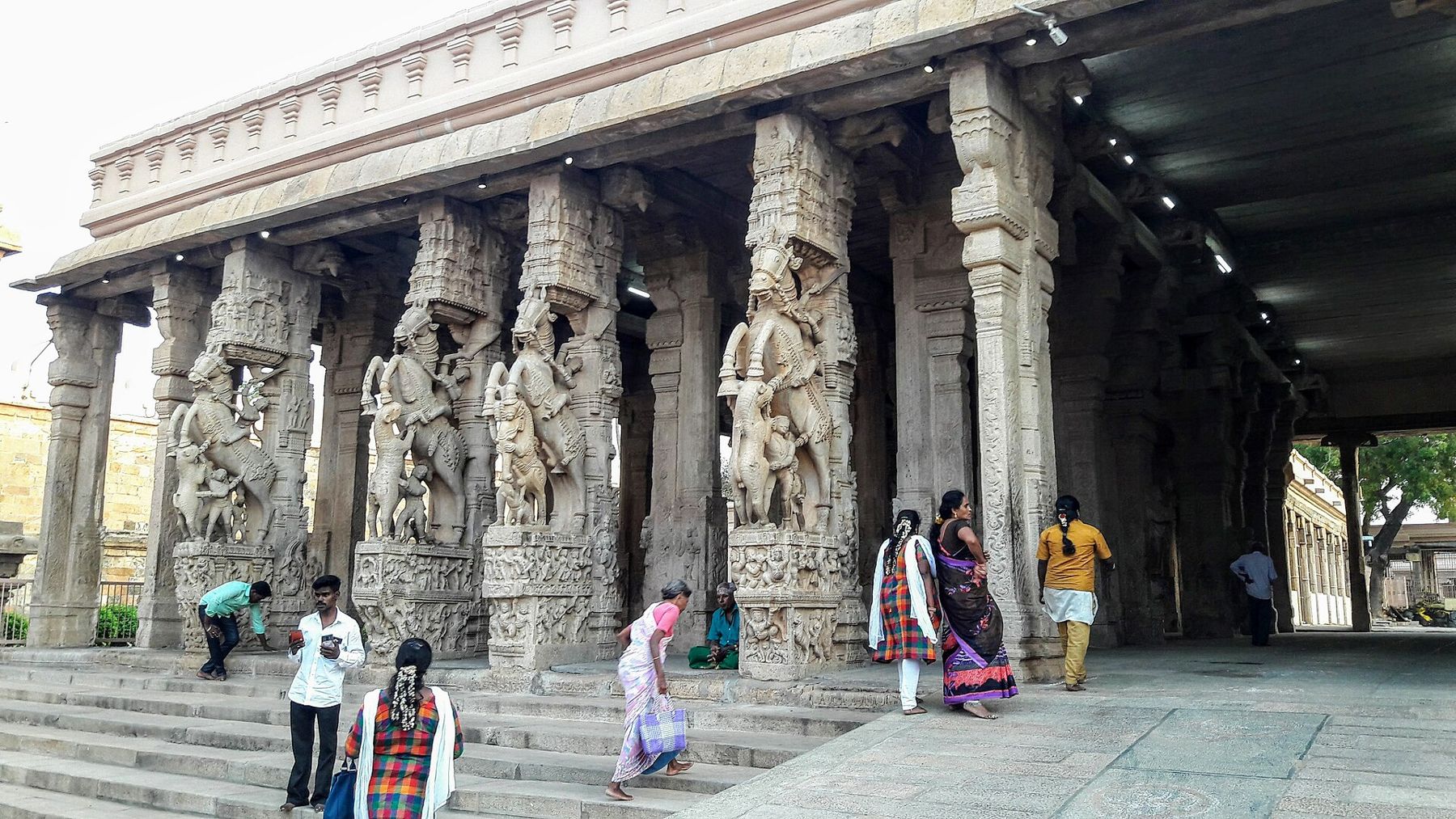
i
Jagavarad · CC BY-SA 4.0The golden vimana
The tower over the inner sanctum is covered in gold, with an image of Vishnu on its side. It is not easily seen from ground level among the surrounding structures. A rooftop viewpoint, usually reached by a stair with a small ticket, has given visitors a view over the roofs toward the gold vimana and the surrounding gopurams. Arrangements change; ask at the temple.
Vaikunta Ekadasi
Storey IV · SrirangamRockfort and the view over the KaveriThe temple's greatest festival day is Vaikunta Ekadasi, in December or January, when a special gate on the north side of the inner enclosure, the Paramapada Vasal or gate of heaven, is opened. Hundreds of thousands of devotees pass through it, and the temple's festival lasts around three weeks. It is spectacular and extremely crowded. Plan carefully if you want to see it, or avoid those days for a quieter visit.
Life inside the walls
What makes Srirangam unique is that the temple is also a town. In the outer enclosures, families live in houses that have stood for generations, children walk to school, and markets sell vegetables and household goods alongside offerings. Many residents are linked to the temple through service, ritual or tradition. Early in the morning, women draw kolam patterns on doorsteps, and the sound of chanting drifts from the inner shrines. It is a place where daily life and worship have been woven together for centuries.
Respect that life as you walk. These are homes and streets, not stage sets. Ask before photographing people, and keep to the public lanes.
Reading the gopurams
Srirangam has around twenty gopurams of different sizes and ages. Some are plain and old, others brightly painted with figures from the stories of Vishnu and his incarnations. Compare them as you walk inward: the outer gateways are larger and later, the inner ones older and smaller. The pattern, with the largest towers on the outermost walls, is typical of later South Indian temples, where each generation added a new, bigger enclosure around the old.
Ramanuja and the temple
The philosopher and teacher Ramanuja, one of the most important figures in the Vaishnava tradition, lived at Srirangam for many years and reorganised the temple's worship. A shrine within the temple honours him. Pilgrims who follow his teachings come here from across India. His presence gives Srirangam a special place in the history of Indian religious thought, not only in its architecture.
Combining with Tiruchirappalli
Srirangam and Tiruchirappalli face each other across the Kaveri and are easily combined in a day or two. Many visitors stay in Tiruchirappalli and cross to the island by bus or auto-rickshaw. A good plan is Srirangam in the morning, the water temple of Jambukeswarar nearby, and the Rockfort climb in the late afternoon for the view back over the island.
Above all, go slowly. Srirangam rewards patience: a pause in a quiet hall, a conversation with a flower seller, a ritual glimpsed through a doorway.
Within the temple, small signboards in Tamil and English mark the main halls and shrines. A printed plan, or simply following the flow of pilgrims toward the centre, will keep you oriented in a complex that is easy to get lost in, especially in the outer streets where every gateway looks a little like the last.
Notes from the gate
- Allow at least half a day. The temple is huge.
- Shoes are left at counters before the temple proper; carry socks for hot stone.
- Men may be asked to wear a dhoti and remove shirts in inner areas; check at the gate.
- Photography is limited in many parts; follow signs.
- The temple closes for part of the afternoon; check hours.
Across the river, climb the Rockfort for the view back to Srirangam's towers. For the festival year, see a year of temple festivals, and for getting here, linking the six towns.