Kailasanathar, the oldest stone in Kanchipuram
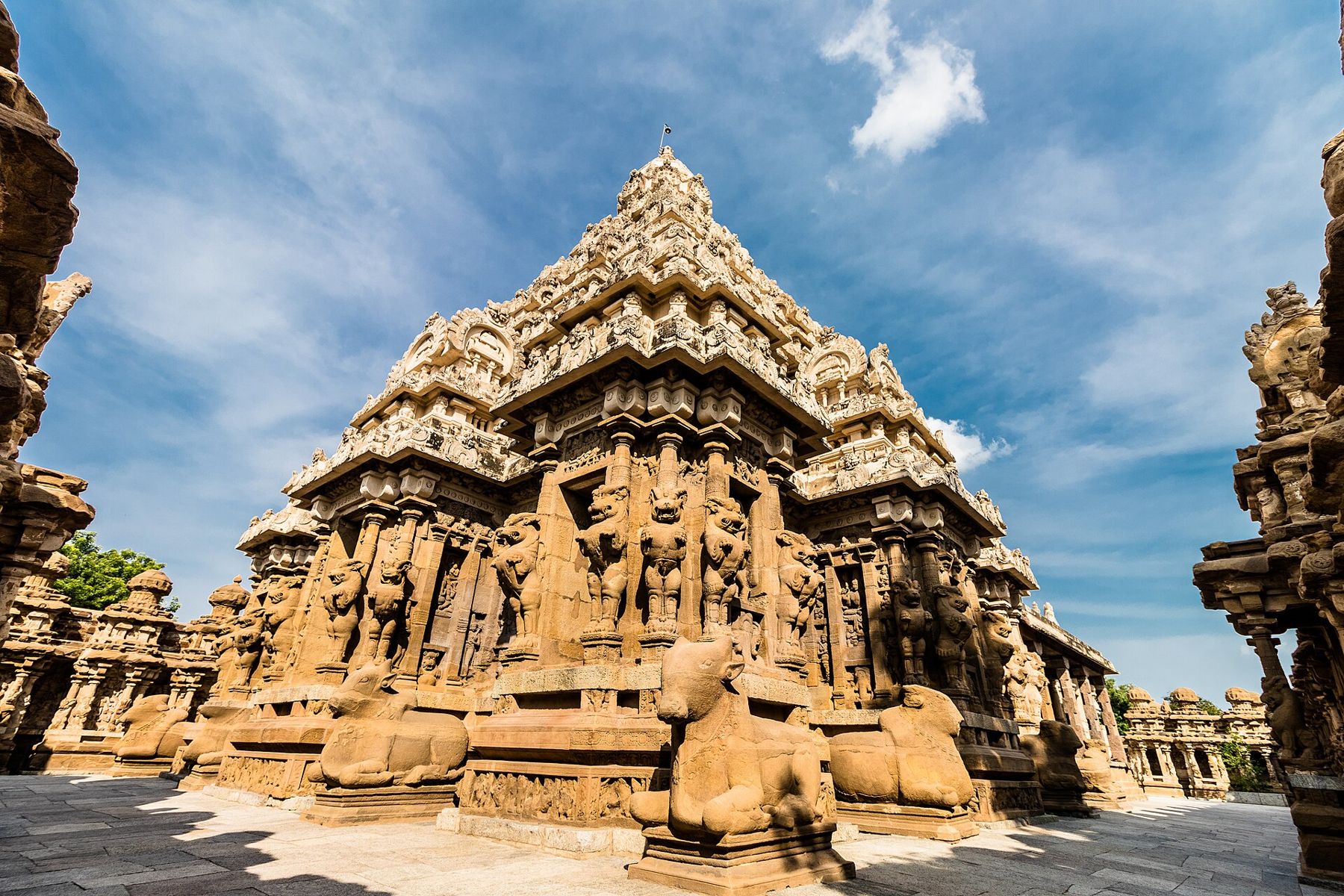
On the western edge of Kanchipuram, a small sandstone temple from around 700 holds the city's oldest stonework: a courtyard ringed with tiny shrines and pillars carried by rearing lions.
i
Jmadhu · CC BY-SA 4.0Kanchipuram is called the city of a thousand temples, and most of them are busy. The Kailasanathar is the exception. It stands a little apart, on the western side of town, and it is the oldest of Kanchipuram's great temples. Built by the Pallava kings around the turn of the eighth century, it predates Thanjavur by three hundred years. Coming here after the big, crowded temples is like stepping into a quieter room.
A Pallava king's temple
The temple was raised by the Pallava ruler Narasimhavarman II, also known as Rajasimha, around the years 685 to 705, and completed under his successor. The Pallavas ruled from Kanchipuram and were among the first in South India to build free-standing temples of dressed stone rather than cutting them into rock. At Mamallapuram, on the coast, you can see their earlier experiments. Here is the mature result.
It is dedicated to Shiva as Kailasanathar, lord of Mount Kailash. Worship continues, on a small scale, and the temple is protected as a national monument.
i
Ssriram mt · CC BY-SA 4.0Sandstone, not granite
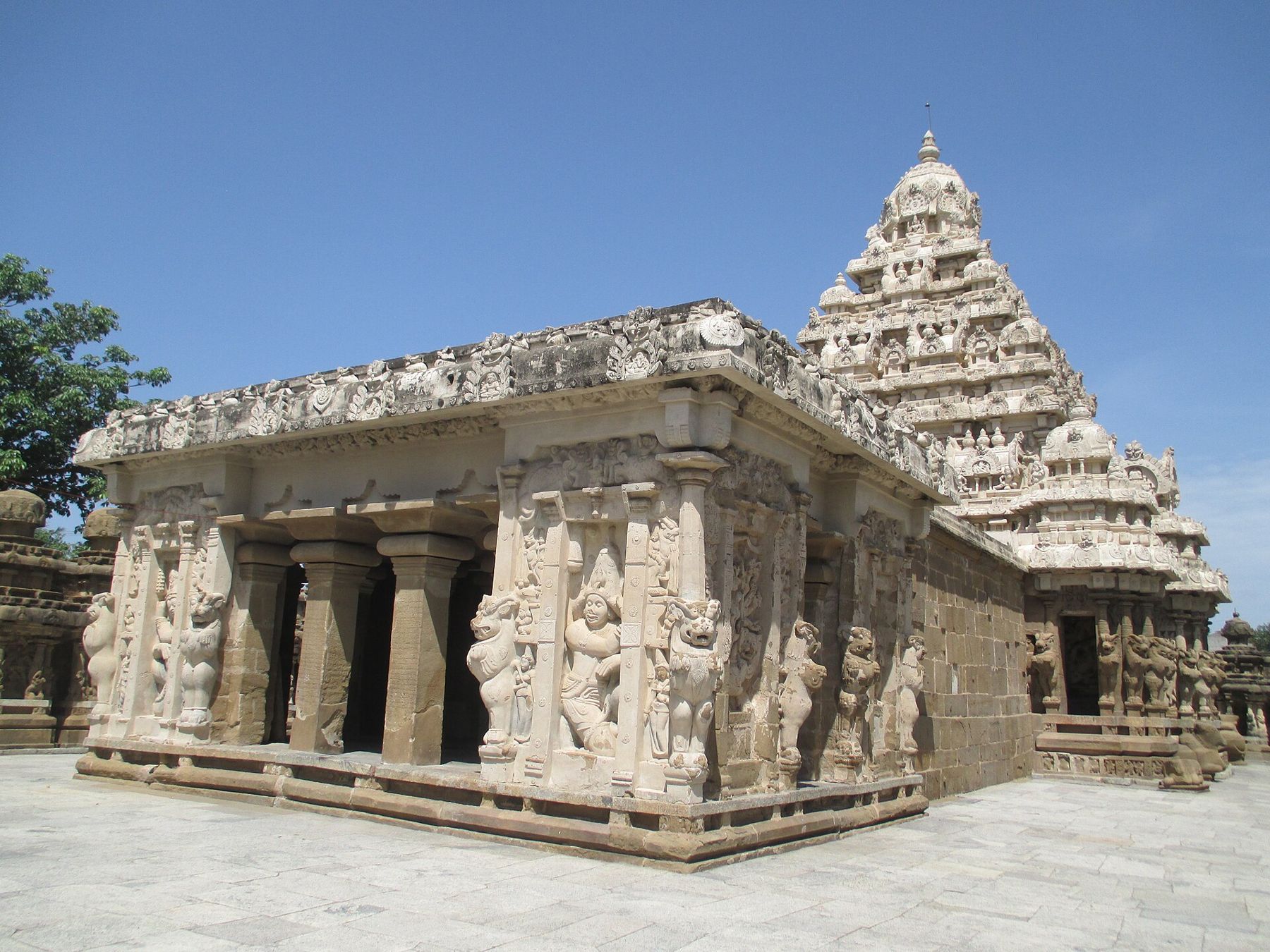
The main material is sandstone, with harder stone used at the base. Sandstone carves easily, which is why the sculpture here is so rich, and it also weathers easily. Many figures have softened into rounded shapes over thirteen centuries, their faces worn smooth. Parts of the surfaces were later covered with plaster, and restoration has added its own layer. Read the temple as a palimpsest: the original Pallava outlines, worn by time, patched by later hands.
Look for traces of paint in sheltered corners. The walls were once coloured, and faint fragments survive in some of the small shrines.
i
Jmadhu · CC BY-SA 4.0The ring of small shrines
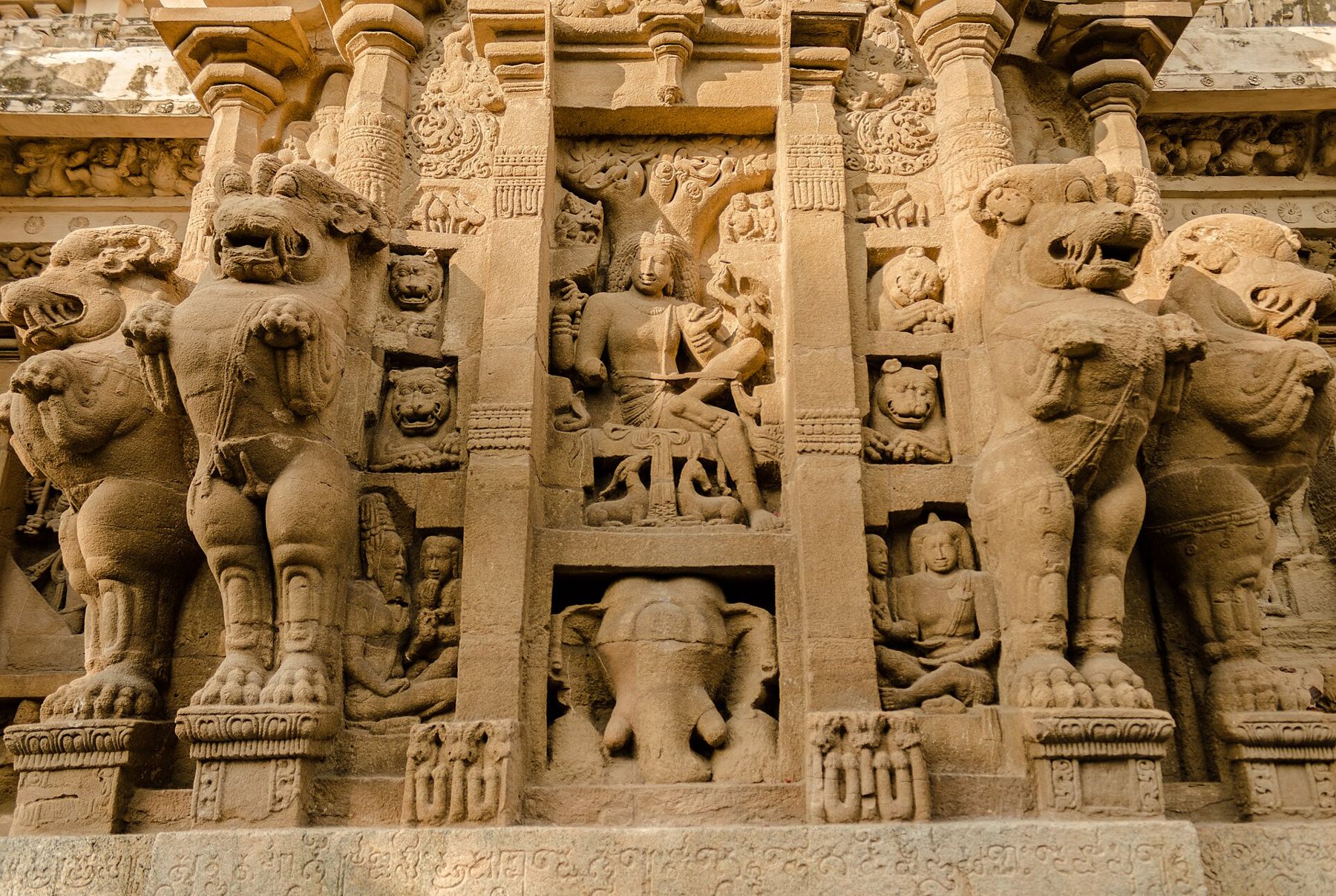
The most unusual feature is the enclosure wall. Instead of a plain wall, it is built as a continuous ring of small cells, dozens of them, each a miniature shrine with its own carved panel. Many show Shiva with Parvati and their son Skanda, a family group the Pallavas favoured. Walking round the inside of the enclosure means passing shrine after shrine, each slightly different, like a gallery.
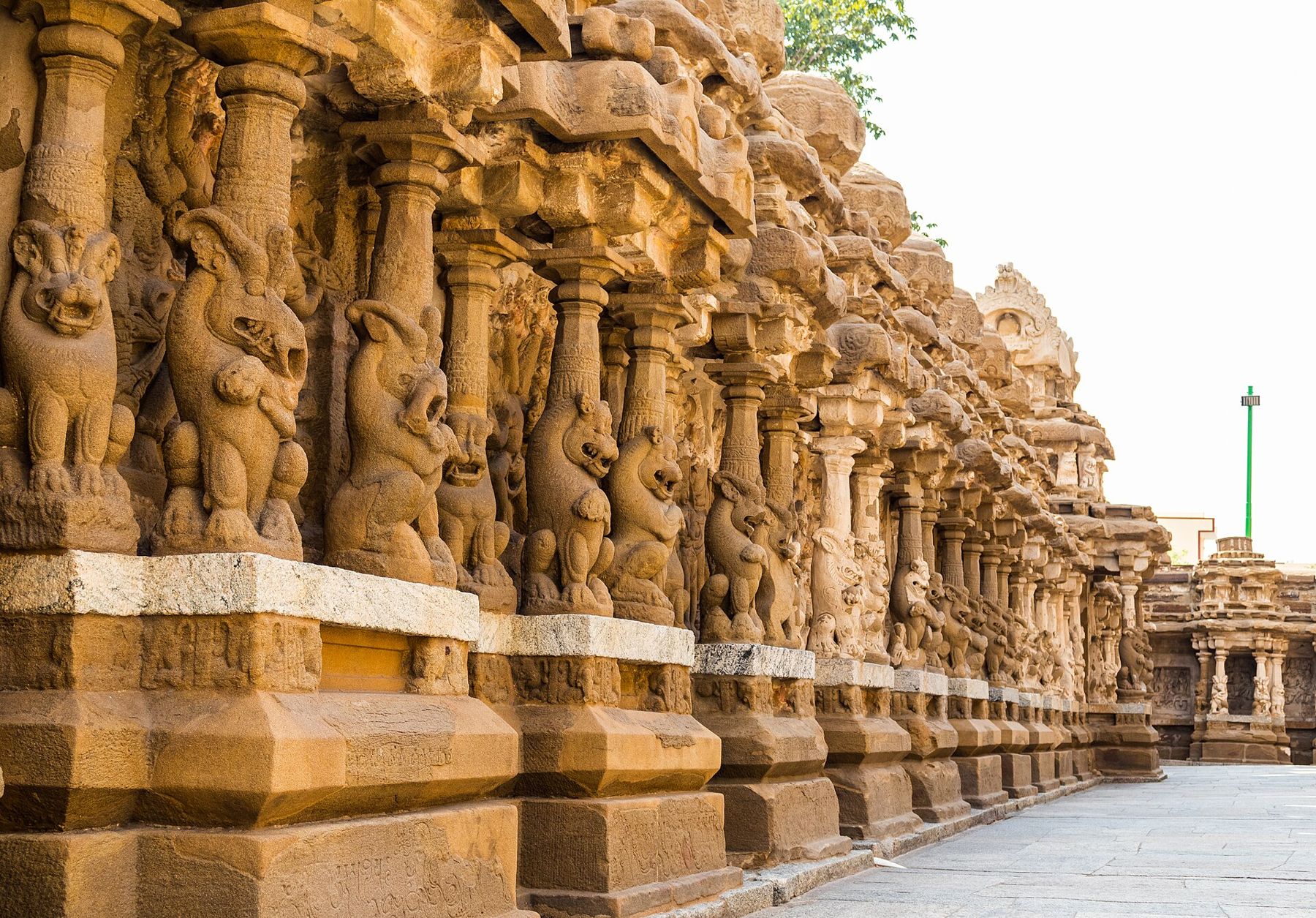
The pillars and pilasters along the walls are carried on the backs of rearing lion-like beasts, a signature of Pallava design. You will see the same motif at Mamallapuram. Here, with the light coming low across the courtyard, the lions throw long shadows and seem to move.
i
Jmadhu · CC BY-SA 4.0Walking round the inside of the enclosure means passing shrine after shrine, each slightly different, like a gallery.
Notice, too, how the shrines are paired with small pavilions and how the corridor between the cells and the main building is just wide enough for a procession. Everything is scaled to people walking: nothing is monumental for its own sake. That human scale is what many visitors remember, and it is why the temple works best at an unhurried pace, without a guidebook open in your hand.
The main shrine
The tower over the sanctum rises in a stepped pyramid, compact and solid, a clear ancestor of the much taller tower at Thanjavur. Around the sanctum runs a narrow passage which devotees traditionally pass through, squeezing in at one side and emerging at the other; the act is said to carry spiritual merit. Whether it is open on the day of your visit, and to whom, is up to the temple staff.
Storey III · KanchipuramEkambareswarar, Varadharaja and the silk lanesThe front pavilion and the gateway are later additions, and the relationship between the parts is easier to read here than in most temples, because the whole complex is small enough to take in at a glance.
Reading a panel
Many of the panels follow a recognisable pattern. In the centre, Shiva sits with Parvati beside him and the child Skanda between them or on Parvati's lap; this family group, called Somaskanda, was the Pallavas' favourite way of showing the god. Around them, smaller figures attend: Brahma and Vishnu at the sides, attendants with fly-whisks, flying beings at the top. Once you recognise the group, you will find it again and again, each time carved a little differently.
Other panels show Shiva in action: dancing, destroying the demon cities, receiving the river Ganga in his hair. The goddess appears in her fierce forms too, riding a lion. If the details are worn, look for the outline of the pose, which usually survives when the faces have gone.
Kanchipuram in the Pallava age
When this temple was built, Kanchipuram was a royal capital and a centre of learning, visited by scholars and monks from far away. The Pallavas traded across the sea, wrote in Sanskrit as well as Tamil, and supported several faiths at once. Buddhist and Jain communities lived here alongside Shaiva and Vaishnava ones. The city's many temples, built and rebuilt over the following centuries by Cholas, Vijayanagara rulers and others, all grew in the shadow of this early prestige.
The Kailasanathar is the clearest survivor of that age within the city. Most of Kanchipuram's other famous temples were enlarged so often that the early core is hard to see. Here the Pallava plan is still legible from end to end.
Compare the lions here with those at Mamallapuram and you can watch a motif settle into a style. The early lions are lively and slightly uneven; these are confident and repeated, almost architectural. Within a century or two, the same creature would become a standard part of the Dravidian temple pillar across the south.
Calling at the temple
The temple usually opens in the morning, closes for part of the middle of the day and reopens in the afternoon. Check the hours locally. Early morning and late afternoon are the best times, when the sandstone glows and the courtyard is cool enough to walk slowly. Shoes stay outside. Photography of the carvings has usually been permitted outside the sanctum.
It sits a short auto-rickshaw ride west of the bus stand, on the edge of the older town. The surroundings are residential and calm. A guardian or priest is usually present; listen to what he asks of visitors, and if you are offered an explanation of the panels, a small offering in return is a kind gesture rather than an obligation.
Give it an hour at least. There is no café or shade beyond the walls, so bring water. In the hottest months, from April to June, come at opening time.
Pair it with the town's busier temples for contrast: the Ekambareswarar and Varadharaja Perumal are both a short ride away, and Ekambareswarar, Varadharaja and the silk lanes covers them. For the Pallavas' coastal monuments, read the Pallava coast at Mamallapuram.