Rockfort and the view over the Kaveri
In the middle of Tiruchirappalli, a great outcrop of ancient rock rises above the rooftops. Steps cut into it lead past temples to a small shrine on the summit, with a view to Srirangam's towers.
i
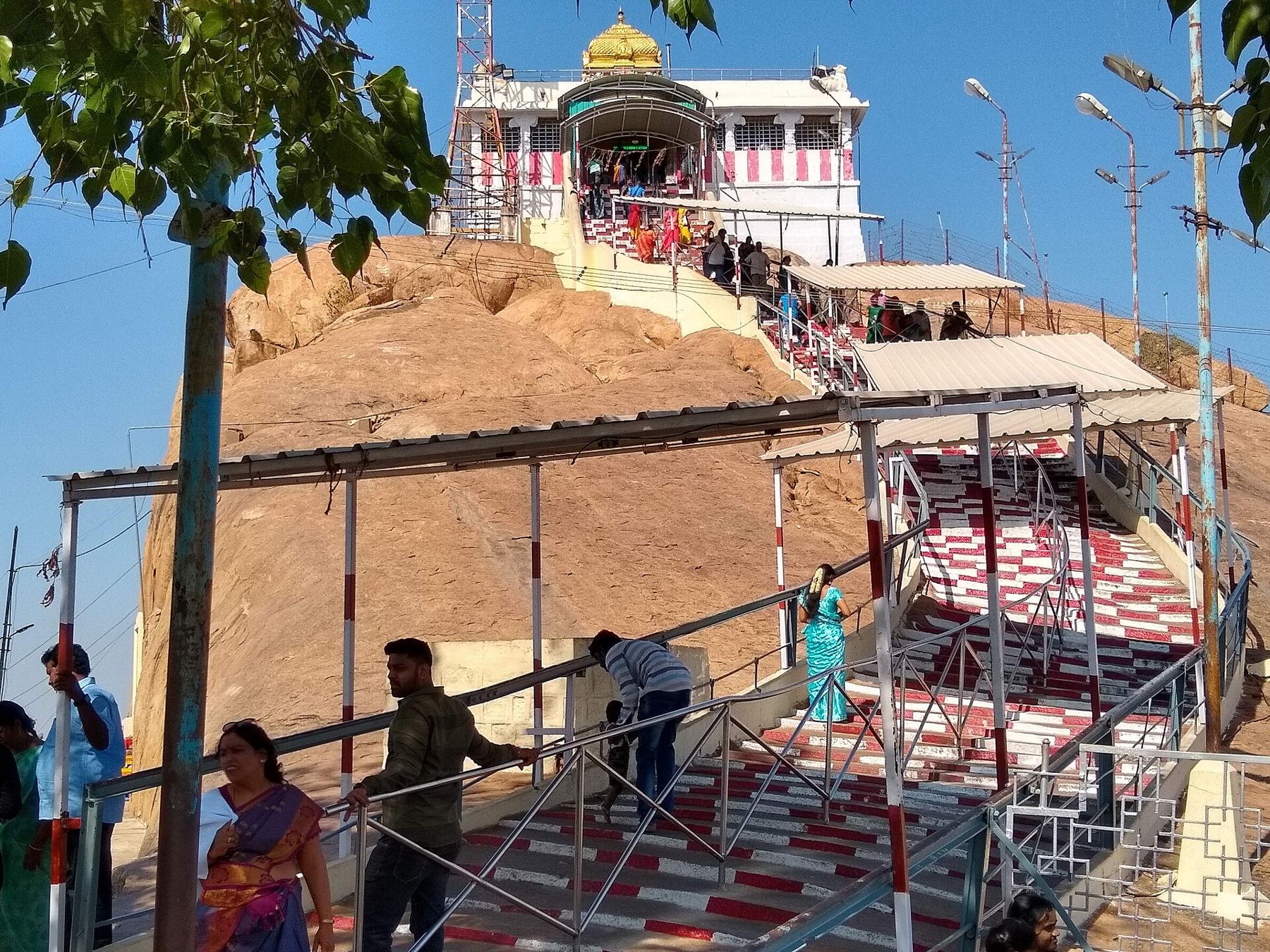
N. Vivekananthamoorthy · CC BY 4.0Tiruchirappalli, usually called Trichy, is a busy city on the south bank of the Kaveri, facing the island of Srirangam. In its centre stands the Rockfort, a huge outcrop of rock rising high above the surrounding streets. The rock is among the oldest in the world, formed billions of years ago. Steps cut into it climb past rock-cut shrines and a large Shiva temple to a small Ganesha temple at the very top, with views across the city, the river and the towers of Srirangam.
Up the rock steps
The climb begins at the base of the rock, through an entrance off a busy bazaar street. From here, a long flight of more than four hundred steps, much of it cut into the rock and roofed over in places, leads upward. Shoes are left at the bottom, and the climb is made barefoot, as for any temple. The steps are steep in places, with landings to rest. Allow half an hour or more for the climb at a steady pace.
Part of the way up stands the Thayumanaswamy temple, dedicated to Shiva, with large halls and pillared corridors built into the rock. Its name recalls a story of Shiva taking the form of a mother to help a devotee in childbirth. Entry to its inner shrine may be limited.
i
Balaji Viswanathan · Public domain
The Ganesha shrine at the top
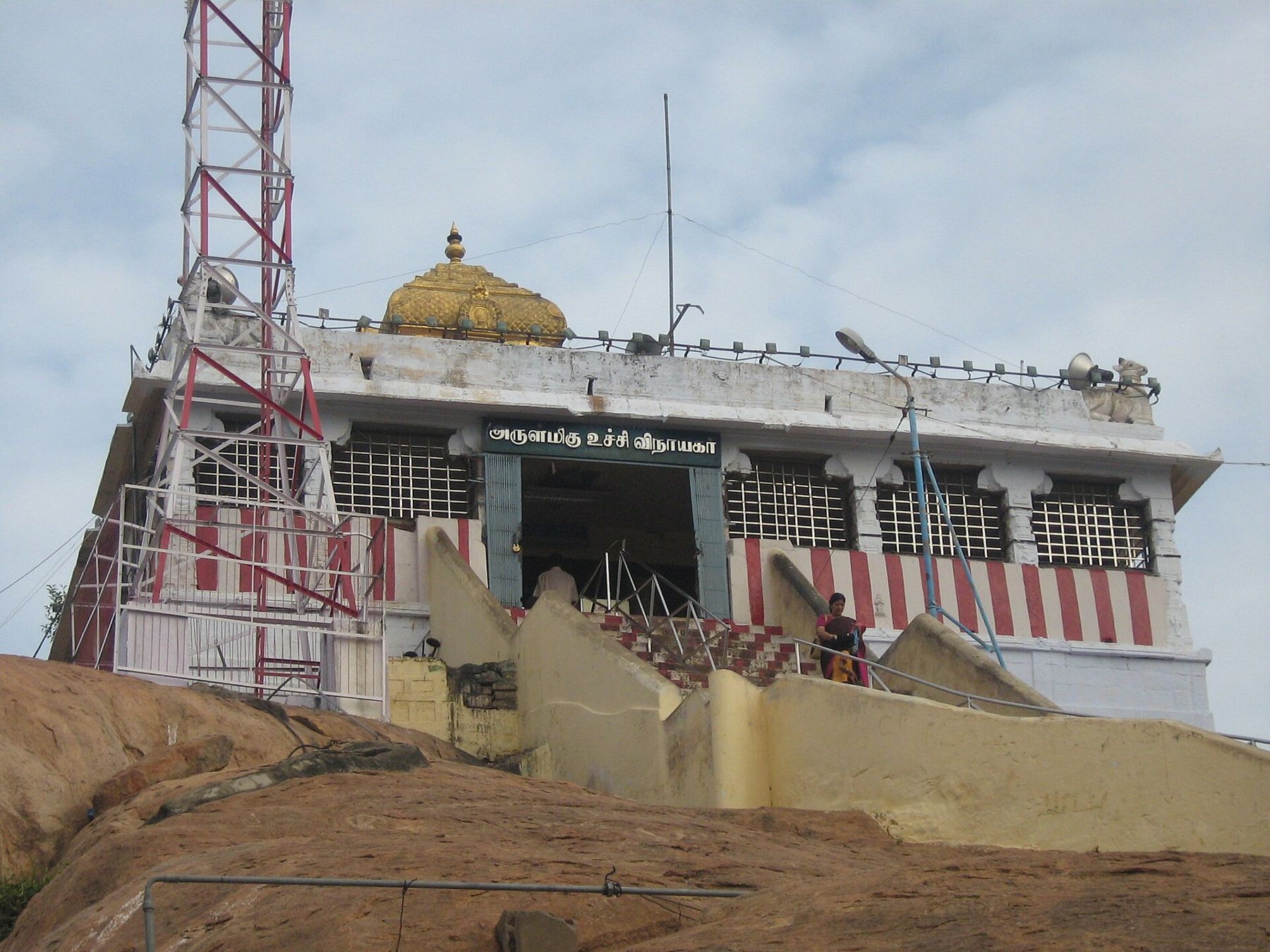
At the summit, the small Ucchi Pillayar temple, dedicated to Ganesha, sits on the highest point of the rock. A story links its origin to the Ramayana and to Srirangam: Ganesha is said to have tricked a demon king into setting down the image of Ranganatha on the island, where it remains, and then fled up the rock. The shrine itself is modest, but the setting is spectacular.
Looking out from the summit
From the top, the whole of Tiruchirappalli spreads out below, with the Kaveri to the north, and beyond it the island of Srirangam with the tall Rajagopuram and the many gopurams of its temple. On clear days, the view stretches far across the plains. The best light is in the late afternoon, when the air is clearer and the towers catch the sun.
Caves and early temples
The rock also holds older shrines. Near the base and on the lower slopes, cave temples cut into the rock date back to the Pallava period, with carved panels of gods. They are smaller and quieter than the main temples and worth seeking out. Ask locally which are open.
Jambukeswarar, the water temple
Storey IV · SrirangamWalking inward through Srirangam's seven enclosuresOn the island of Srirangam, close to the great Vishnu temple, the Jambukeswarar temple at Thiruvanaikaval is one of the five Shiva temples representing the five elements, here water. Its lingam is set in a sanctum where a small spring keeps water around it. The temple has five enclosures, fine pillared halls and an atmosphere quieter than its huge neighbour. As elsewhere, the inner shrine may be closed to non-Hindus.
i
Beckamrajeev · CC BY-SA 3.0The Kaveri
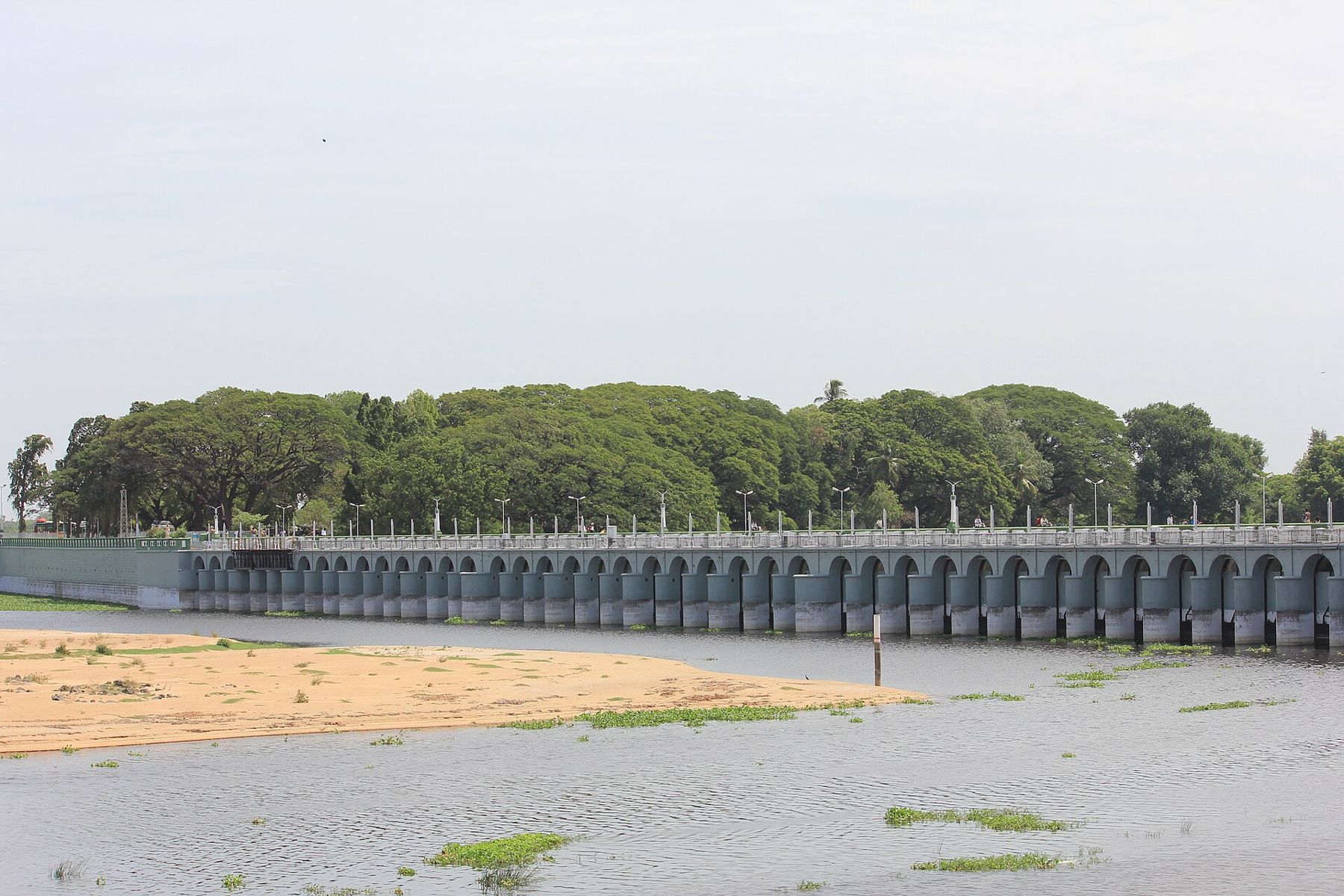
The Kaveri is the great river of Tamil Nadu, sacred and vital for the rice fields of the delta. At Tiruchirappalli it divides around Srirangam. Bathing ghats line its banks, and festivals celebrate its waters, especially in the month of Aadi, around July and August, when crowds come to offer prayers at the river. A short distance upstream lies the Kallanai, an ancient dam on the river associated with the early Chola king Karikala, still part of the irrigation system.
Tiruchirappalli below the rock
The streets around the base of the Rockfort are among the busiest in the city, with bazaars selling everything from textiles to household goods. The old fort that gave the rock its name has largely disappeared, but the Main Guard Gate and traces of walls survive nearby. A temple tank at the foot of the rock, with a pavilion in its centre, adds to the scene. The city was fought over in the eighteenth century by rival powers, including the British and French, and the rock was a key stronghold.
Today Tiruchirappalli is a large, practical city, an educational and industrial centre, and a convenient base for Srirangam and the delta temples.
When to climb
Early morning is cool and quiet, with soft light over the city and the river. Late afternoon brings the clearest views toward Srirangam and the best chance of a sunset over the plains, but more people. Avoid the middle of the day in the hot months, when the bare rock reflects the heat and the steps become uncomfortable underfoot. On festival days, especially around Ganesha's festival, the climb can be very crowded.
On the way up, pause at the landings to look out through the openings in the rock. The city noise fades as you climb, replaced by wind, bells and the calls of kites wheeling around the summit. Monkeys sometimes gather on the steps; keep food out of sight.
Notes from the gate
- The Rockfort temples usually close for part of the afternoon; check hours.
- Climb in the morning or late afternoon; the rock heats up in the sun.
- Carry water; there is little on the way up.
- A small fee may be charged for entry or cameras.
- The bazaar streets around the base are crowded; mind your belongings.
Cross the river to Srirangam's seven enclosures, and plan the onward journey with linking the six towns. For the Kaveri delta's other great temples, see Thanjavur's Brihadeeswarar.