The Pallava coast at Mamallapuram
On the shore south of Chennai, the Pallava kings carved temples out of boulders and cliffs, then built one on the edge of the sea. The whole town is an open-air workshop of early Tamil temple design.
i
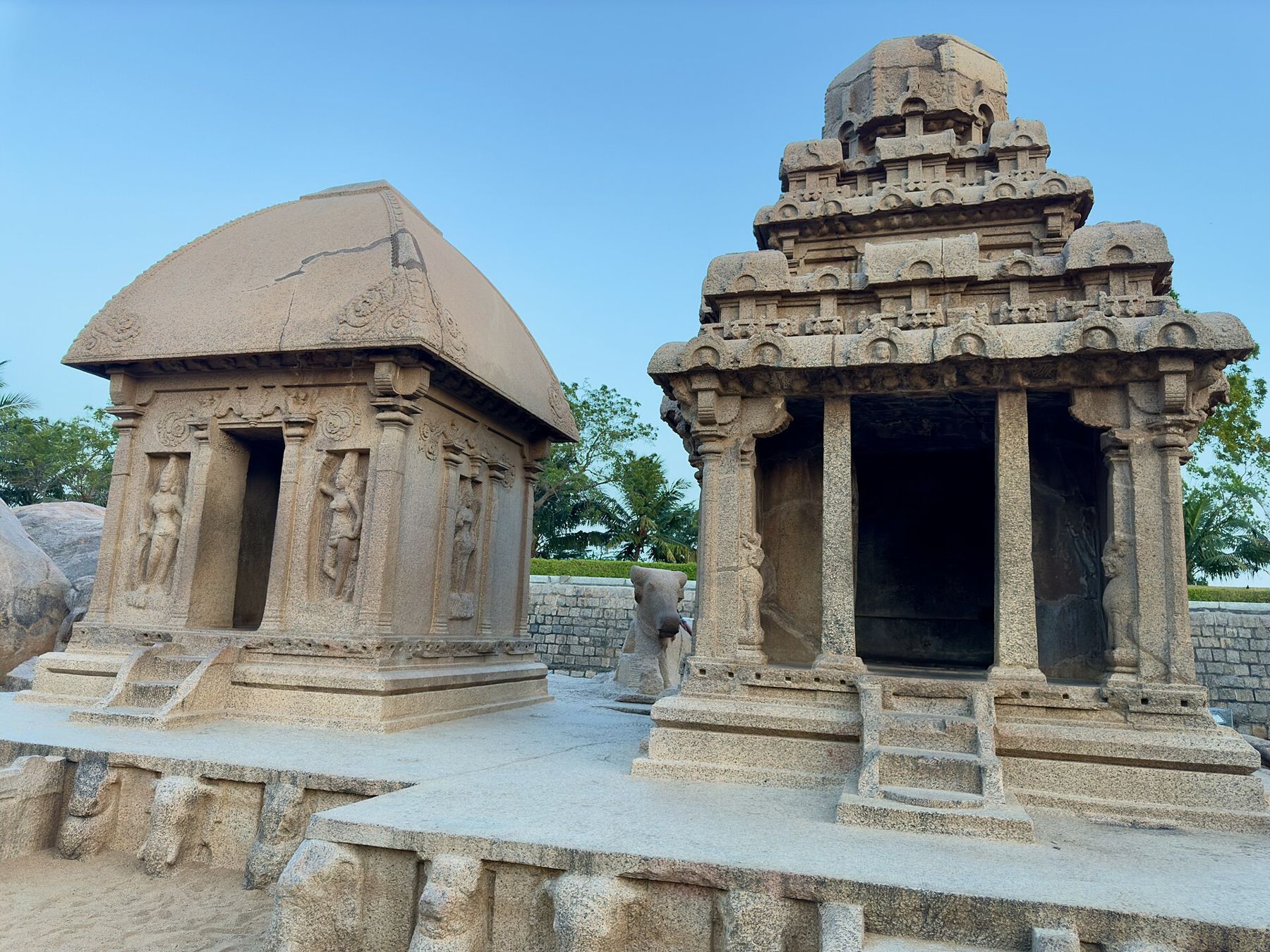
Oleg Yunakov · CC BY-SA 4.0Before the Pallavas built the Kailasanathar at Kanchipuram, they practised on the coast. At Mamallapuram, also called Mahabalipuram, about sixty kilometres south of Chennai, their sculptors cut shrines into granite outcrops, carved whole temples from single rocks and covered a cliff face with one of the largest reliefs in the world. The group of monuments is a UNESCO World Heritage Site, and most of it can be walked in a day.
Why the Pallavas carved here
Mamallapuram was a port in the seventh and eighth centuries, and the name comes from Mamalla, a title of the Pallava king Narasimhavarman I. The landscape is full of granite boulders and low ridges, ideal material for carvers. Many of the monuments look like trials: different shapes of shrine, different kinds of roof, different ways of arranging figures. Seeing them together is like reading the first drafts of the temple forms that later filled Tamil Nadu.
The Pancha Rathas
The five rathas, or chariots, are temples carved out of single outcrops of rock in the seventh century. Each has a different shape: one like a thatched hut, others with stepped pyramid roofs or a barrel-vaulted top, a form later used for gateway towers. Life-size carved animals stand among them, including an elephant and a lion.
They were never consecrated for regular worship, and some were left unfinished, which makes them even more interesting: you can see how the carvers worked from the top down. The rathas are named after the heroes of the Mahabharata, but the names came later and are traditional rather than original.
Arjuna's Penance
In the centre of town, a pair of huge boulders has been carved into a single scene about twenty-seven metres long and nine high. Hundreds of figures, gods, humans, animals and serpent beings, gather toward a natural cleft in the rock. The scene is usually read as the descent of the Ganga from heaven, or as Arjuna's penance to win a weapon from Shiva; scholars still debate it, and both names are used.
Storey III · KanchipuramKailasanathar, the oldest stone in Kanchipuram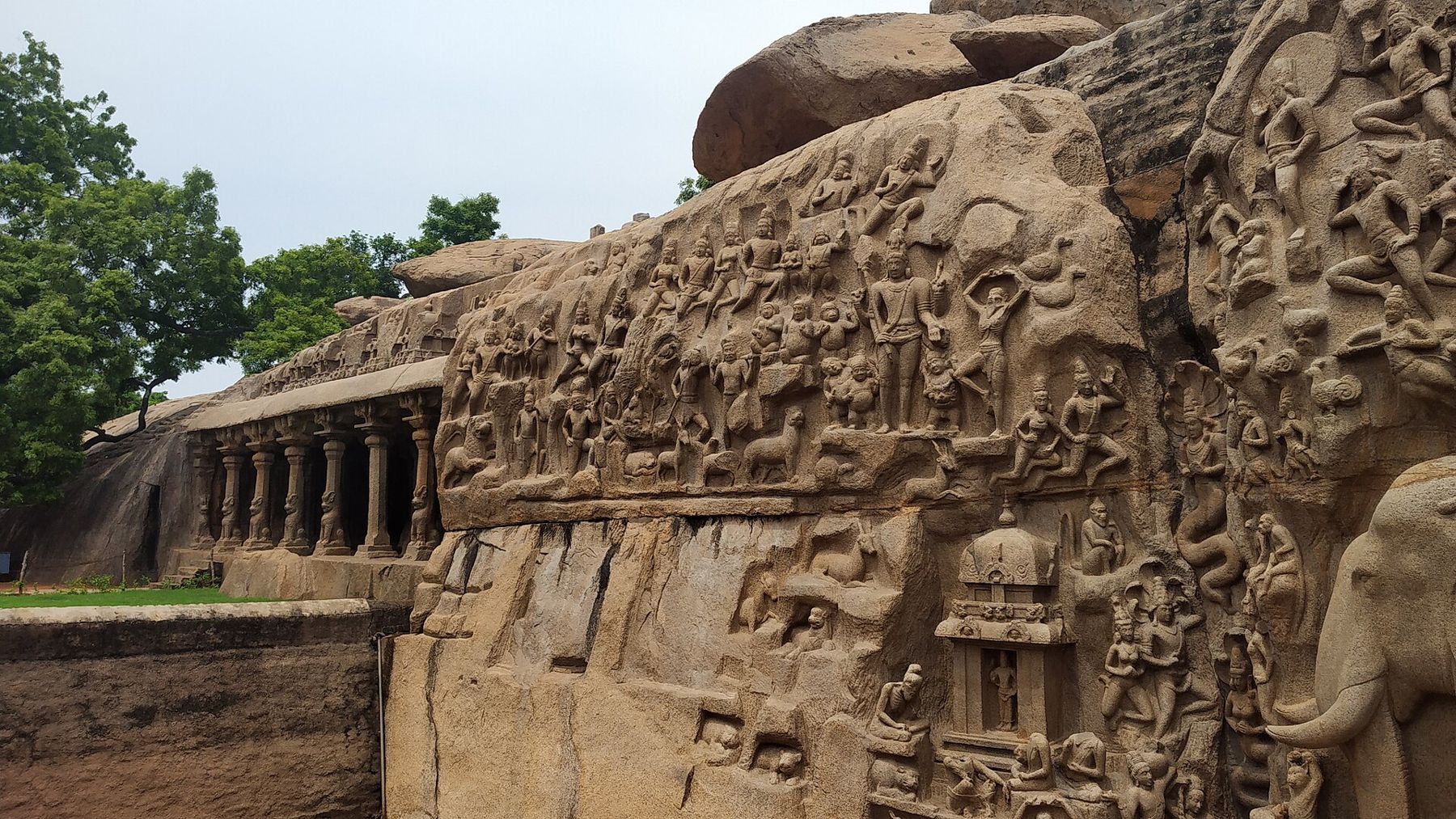
i
Sichu7 · CC BY-SA 4.0Spend time with the details. A pair of elephants with their young walk along the bottom. A cat stands on one leg in a parody of the ascetic above it, while mice gather round. Water was once channelled down the cleft, so the river would appear to flow.
The Shore Temple
Built in the early eighth century under Rajasimha, the same king behind the Kailasanathar, the Shore Temple is a structural temple of dressed granite rather than a carving. It stands at the very edge of the sea, with two towers and rows of Nandi figures along its enclosure wall. The salt wind has softened its carving, and a protective barrier keeps the waves back.
The 2004 Indian Ocean tsunami briefly pulled the sea back along this coast and exposed traces of other structures offshore, which fed old stories of a drowned group of temples. Excavations nearby have found more remains; the full picture is still being studied.
Around the hill
On the ridge behind the town are cave temples cut into the rock with carved panels inside, a lighthouse and a balanced boulder known as Krishna's Butterball, which seems about to roll down the slope and never does. The ridge is good for the views and for the evening breeze.
Allow a full morning for the central group of monuments: Arjuna's Penance, the nearby cave temples and the hill. The Pancha Rathas lie a short walk south, and the Shore Temple is on the beach to the east. Distances are small, but heat and sand slow everyone down, and there is a lot to look at.
The cave temples
Scattered around the town are cave temples, called mandapas, cut into the rock face. Inside, carved panels show scenes that became classic subjects: the goddess Durga battling the buffalo demon, Vishnu reclining on the cosmic serpent, Krishna lifting a hill to shelter cowherds from a storm. The Krishna panel, close to Arjuna's Penance, is full of gentle details: a cowherd milking, a calf licking its mother, people sheltering together.
These interiors are small and shaded, a relief in the heat. Let your eyes adjust and the reliefs appear out of the gloom, often more crisply preserved than the carvings outside, since they have been protected from wind and salt.
A town that still carves
Stone carving never left Mamallapuram. Workshops along the streets produce temple images and sculptures for buyers across the country, and the sound of chisels is part of the town. A government college for traditional architecture and sculpture is based here as well. The link between the Pallava carvers and today's craftspeople is not a straight line of descent, but the skill and the stone are the same, and the continuity is real.
Hours, heat and tickets
Go early. The granite reflects the heat by late morning, and there is little shade at the rathas or the Shore Temple. The main protected sites are managed by the Archaeological Survey of India and have usually required an entry ticket covering several monuments; check the current arrangement on arrival. Sunset at the Shore Temple is popular, and the beach beside it fills with families in the evening; bathing here is risky because of strong currents.
Mamallapuram fits naturally with Kanchipuram, about an hour and a half inland. Read Kailasanathar, the oldest stone in Kanchipuram for what the Pallavas built next, and linking the six towns for the route south toward Chidambaram.